
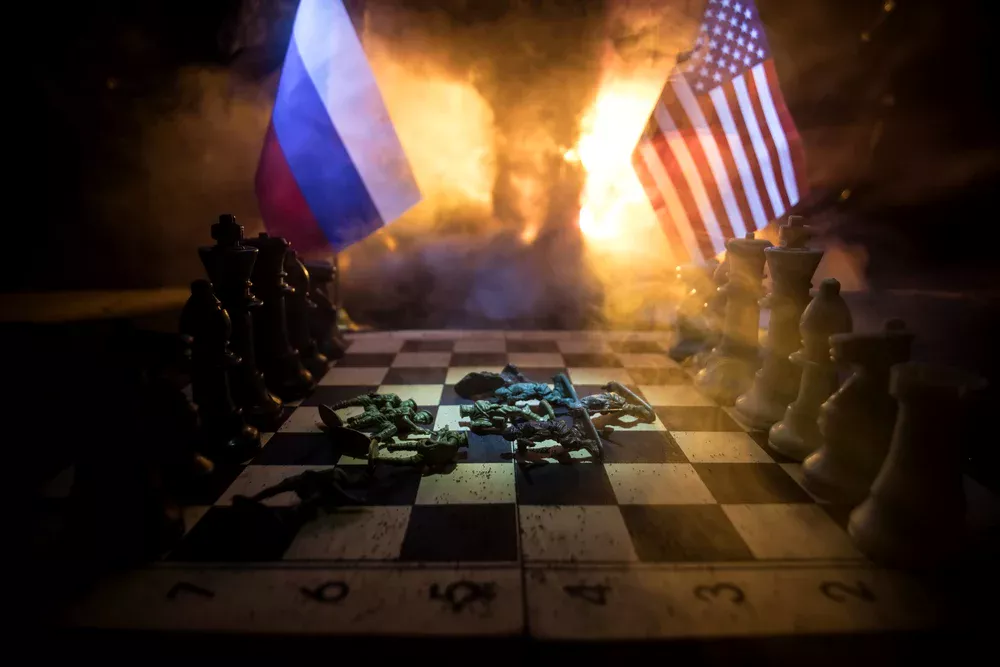
Recent events in global politics – including the unilateral military interventions of major powers – are not important for the specific cases they produce, but for the rules they destroy. The overthrow of an authoritarian leader in a distant state, such as Venezuela, is just a pretext. The real stake is the normalization of the idea that major powers can decide the fate of small states, based on their own interests, not on international law, states an editorial signed by analyst Anatol Țăranu.
For the Republic of Moldova, this paradigm shift is existential. A small state, militarily weak, identity fragmented and with a frozen conflict on its territory cannot resist in the long term in a world governed by force. The international order based on rules – the only framework that allowed Moldova to exist as an independent state – is rapidly eroding. And in its place appears a world of spheres of influence, where sovereignty is negotiable.
Russia’s war against Ukraine is the clearest demonstration. The Kremlin did not attack Ukraine because it represented a real threat, but because it decided to accept the definitive exit from the Russian world. The arguments invoked – “protecting Russian speakers”, “denazification”, “correcting a historical error” – are simple ideological tools. The real goal is to regain control over the space considered by Moscow as geopolitical property.
The Republic of Moldova is exactly in the same imperial logic. The Transnistrian region is not a historical accident, but a tool to keep Moldova in the Russian sphere of influence. The presence of Russian troops on the territory of the republic, despite international commitments, is the expression of a harsh reality: Russia does not recognize the Republic of Moldova as a fully sovereign state, but as a temporary territory that has slipped out of control.
In this context, neutrality is not a solution, but a dangerous illusion. Neutrality only works where it is respected by all actors. The Republic of Moldova is “neutral” only on paper. In reality, it is partially occupied, energetically blackmailed, informationally infiltrated and politically conditioned. A small and isolated state cannot counter such systemic pressure.
Here comes the essential dimension, often avoided out of political cowardice: Romanian identity is not a secondary cultural issue, but a fundamental geopolitical option. To claim yourself Romanian in the Republic of Moldova means to explicitly affirm the definitive exit from the Russian world – from the authoritarian, imperial, revisionist space. It is an act of strategic demarcation, not just of historical memory.
The Romanian language, common history, civilizational belonging are not simple symbolic arguments. They are vectors of security. They define the direction of development, possible alliances and the survival framework. A Moldovan “neutral”, “multivectorial” and “equidistant” state is exactly what Moscow wants: a buffer territory, weak, controllable.
Therefore, the idea that the Republic of Moldova could become a “success story” by remaining alone is a dangerous fiction. A small state, without a functional army, without security guarantees and with occupied territory cannot survive in the long term in a world of spheres of influence. European integration is necessary, but insufficient in the current security context.
The only realistic option that transforms the Republic of Moldova from a geopolitical object into a geopolitical subject is the Union with Romania. Through union, the Republic of Moldova does not “disappear”, but metamorphoses: from a vulnerable state into a regional medium power, a NATO and EU member, with real and irreversible security guarantees.
The Union is not a romantic gesture or a historical revenge. It is a strategic decision for national survival. It definitively closes the Transnistria file as a tool of Russian blackmail, secures the eastern border of the European Union and irreversibly anchors the space between the Prut and Nistru in the Western world.
In a world where major powers are redesigning their spheres of influence, to remain alone means to be absorbed. For the Republic of Moldova, the alternative is not between “statehood” and “union”, but between controlled disappearance and strategic survival.
Romanian identity is not the past of the Republic of Moldova. It is its geopolitical future. And the Union is no longer an emotional option, but the last rational chance to exist in a world that no longer forgives weakness.
Details https://ipn.md