
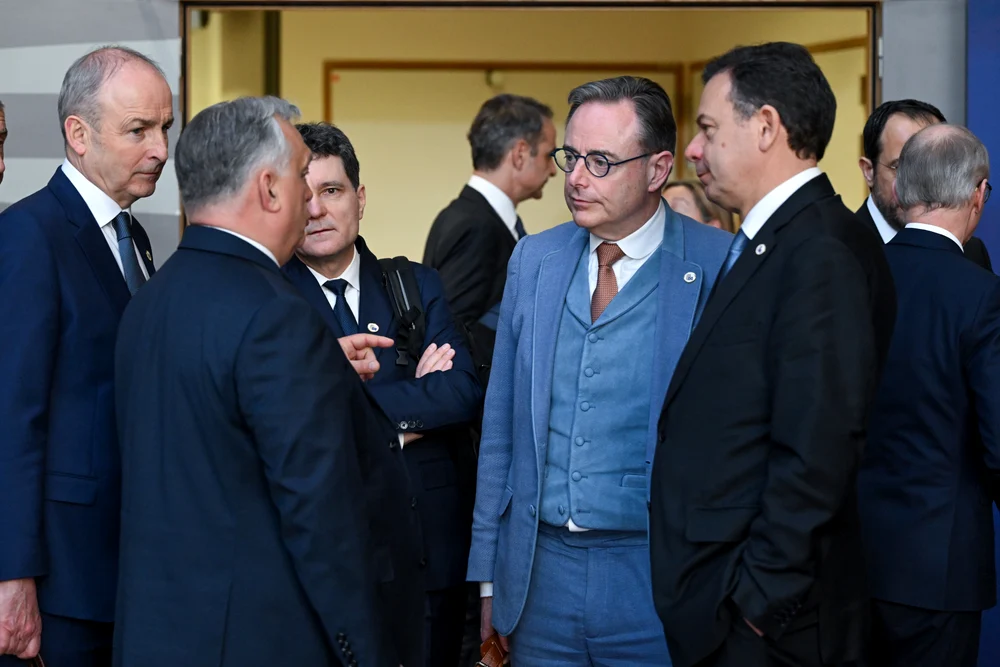
The leaders of the European Union failed to convince the Hungarian Prime Minister, Viktor Orban, to give up blocking the 90 billion euro loan intended for Ukraine, after about an hour and a half of discussions in Brussels, within the European Council. “Adevărul” spoke with political scientist Sergiu Mișcoiu and Gabriela Ciot, a professor in international relations and European law at Babeș-Bolyai University, about the calculation behind Budapest’s position and the limits that the institutional architecture of the EU imposes in such situations.
The pretext invoked by Budapest is the dispute over the Druzhba pipeline, through which Russian oil reaches Hungary and Slovakia by transiting Ukrainian territory. Kiev argues that the infrastructure was damaged by Russian attacks, while Budapest and Bratislava accuse it of delaying repairs.
“Until there is oil, there will be no money,” Orban stated before the meeting of the leaders from the EU member states, in Brussels.
The tension is all the more acute as the loan had already been agreed upon by the member states in December. The President of the European Council, Antonio Costa, described the blockade as a breach of agreements between partners, a rare situation, as decisions agreed at the level of EU leaders are usually respected by all signatories.
In the meantime, Ukraine is approaching a liquidity crisis. The government in Kiev allocates most of its revenues for defense, and in the absence of external aid, it may be forced to reduce funding for vital sectors or resort to printing money, risking severe economic disruptions.
Beyond the technical arguments, analysts see behind the blockade an electoral calculation: Orbán is in full march towards the elections in April, and the topic of Ukraine occupies a central place in his campaign speech. For this reason, many European leaders prefer to avoid an escalation that could interfere with Hungarian domestic politics.
Details, HERE