
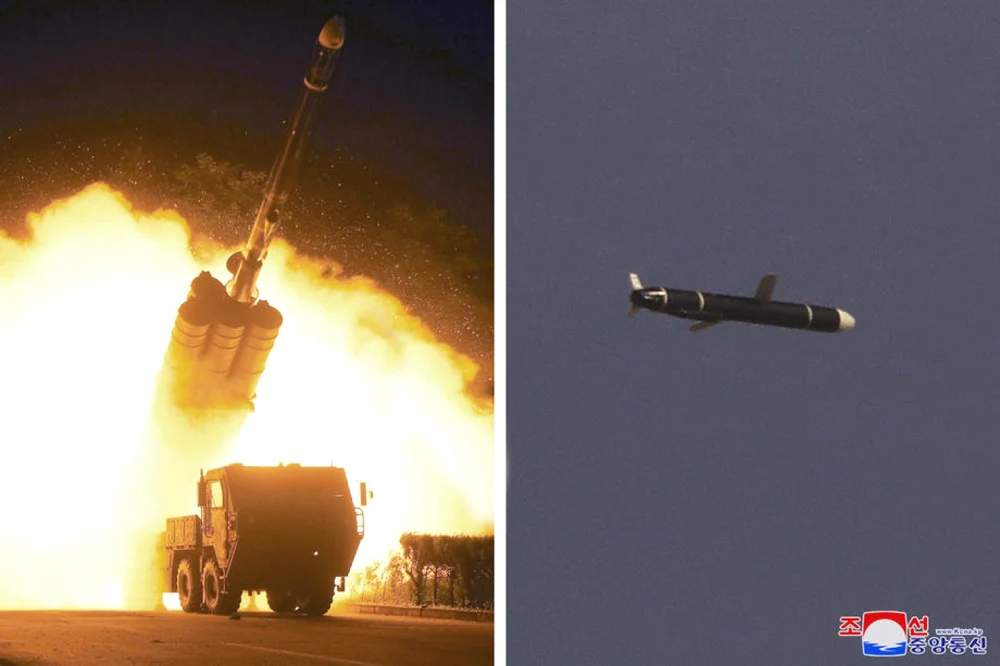
North Korea has begun practicing massive attacks that combine unmanned systems with conventional weaponry, using a tactic already employed in Russia’s war against Ukraine and in the Middle East. This could pose a challenge to the United States and its allies’ anti-aircraft defense systems, writes The Wall Street Journal.
North Korean exercises with “concentrated fire”
This month, North Korea conducted for the first time exercises in which it combined attack drones, missiles capable of carrying nuclear warheads, rocket projectiles, and long-range artillery to destroy a target. According to the North Korean state press, these exercises aimed to perfect the coordination between different weapon systems, through the so-called “concentrated fire”, capable of “structurally destroying the enemy’s armed forces”.
Testing Hypersonic Missiles
Subsequently, on September 20, Pyongyang announced that it had launched two hypersonic missiles. Such missiles, designed to fly at a speed at least five times greater than the speed of sound, can overcome anti-aircraft defense systems due to their speed and ability to change their flight trajectory. North Korean leader, Kim Jong-un, who attended the testing, called these missiles the embodiment of an “ultra-modern” technology.
Test launches for reactive artillery
Thursday, September 24, the North Korean media reported on test launches of projectiles for a multiple launch rocket system (MLRS), with a caliber of 240 mm, with improved guidance systems and an increased range.
The tactic of multidimensional attacks
Multidimensional attacks, which involve the widespread use of drones and missiles, have become a common feature of Russia’s war against Ukraine and are increasingly frequent in the conflict between the USA and Iran. Such combined strikes expose the vulnerability of Western air defense systems, which rely on costly interceptors.
The tactic of massive attacks can overtax the anti-aircraft defense of an adversary, even if they have modern defense systems, asserts Ankit Panda, senior researcher at the Carnegie Foundation for International Peace.
“This significantly changes the arithmetic of air defense,” he added.
The attacks with a large number of projectiles are logistically complex, as they require integrated systems, capable of coordinating strikes with weaponry moving at very different speeds. It is a particularly difficult task for North Korea, which is facing a lack of funds and does not have the highest level military equipment.
Details, HERE