
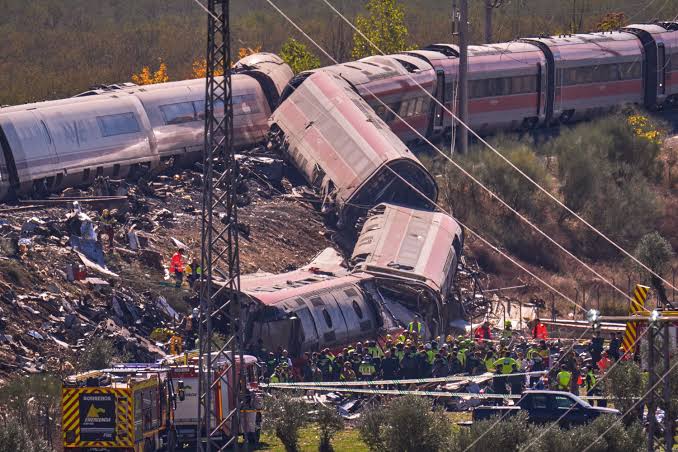
At least 68 people have lost their lives in a collision between two passenger trains near Urda, in the province of Toledro in central Spain. The death toll is preliminary and could rise.
Two high-speed trains collided on the morning of October 28. Nearly 550 people were on board, and more than 150 were injured.
The trains were travelling in the same direction on the high-speed line linking Spain’s capital, Madrid, with Seville in the southwest of the country.
Transport Minister Óscar Puente said that an initial review of the evidence points to an “inexplicable” decision to order crews to continue their journeys despite a signalling system failure. These circumstances suggest that the tragedy was caused by human error.
Spanish media reported that the operator in charge was questioned by investigators on Wednesday afternoon. Spain’s Civil Guard questioned the traffic controller responsible for the section of railway where the accident occurred, according to news.ro. The questioning is part of an investigation launched by Spain’s Railway Accident Investigation Commission (CIAF).
Wednesday’s collision is Spain’s second major rail accident this year and the third deadliest on the country’s rail network in the past 50 years.
Three days of national mourning are expected to be declared.
The speed with which Spain’s transport minister outlined the general circumstances of the accident seems unusually swift for the immediate aftermath of such an event. This may be due to the scale of the accident and the nature of the findings, but it also owes much to growing dissatisfaction and concern over the state of the country’s rail infrastructure.
Meanwhile, the foreign press reports that many questions remain unanswered following a recent collision under similar circumstances in Bedford, in the United Kingdom. There, one train struck another from behind. Fortunately, the trains were travelling at low speed, and only one person was injured. The investigation’s findings suggested that human error had caused the collision, though there was also a fault in the automatic warning system that has yet to be explained.
Spain has singled out individuals for blame in the past, bringing charges against the train driver who recklessly sped into a bend in Galicia in 2013, killing 79 people.
The tragedy in Toledo is the second this year. In January 2026, 46 people died in another collision between two trains near Adamuz, in the province of Córdoba.