
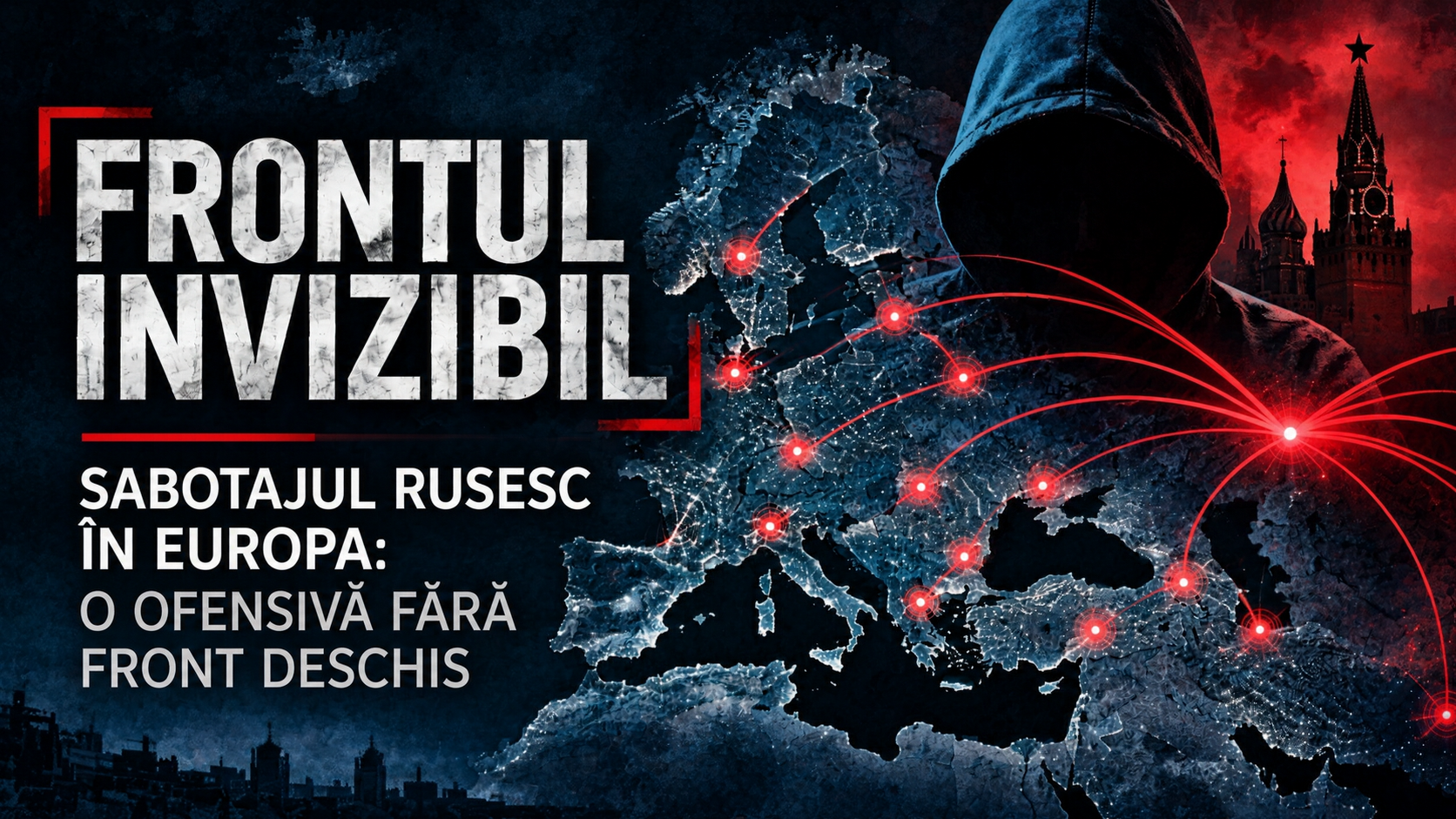
Factories set ablaze, power grids attacked, communications disrupted, and assassination attempts. As part of its “Invisible Front” campaign, DISINFO documents a year of sabotage and destabilization operations across Europe, attributed to Russia or under investigation for possible links to Moscow. We present the facts, the evidence, and the consequences of a war being waged beyond the front lines in Ukraine.
While the world’s attention is focused on the front lines in Ukraine, European security services are warning of an escalation in another kind of war—one without formal declarations, without a clearly defined front line, and in which identifying those responsible for attacks can take months. The targets include factories, power plants, communications networks, public institutions, and more.
On 24 November 2026, Britain’s security service MI5 and the Ministry of Defence issued a joint alert, warning that Russia had stepped up its sabotage attempts against facilities in Europe’s defence industry. British companies supplying equipment to the Ukrainian military, including those indirectly involved in supply chains, were urged to strengthen their security measures.
Meanwhile, the British government held special briefings for executives of defence companies and firms that operate critical infrastructure.
The warning does not come in a vacuum. Incidents documented across Europe between November 20, 2025, and November 20, 2026, paint a picture of a threat that extends beyond national borders and the military sphere.
Estonia closes its border with Russia
One of the most recent cases to prompt a firm response from the European authorities occurred in Estonia.
On November 14, 2026, an attempted arson attack on Threod Systems, a manufacturer of drones and military equipment, was thwarted. Eight people were detained. According to Estonia’s Internal Security Service, the operation was ordered by Russia’s military intelligence agency, the GRU.
This is not the first incident of its kind in Estonia. In August, another defense company, Milrem Robotics, was targeted in an attack later attributed to Russian intelligence services.
Following the incident in November, the Estonian authorities announced that, starting on December 1, they would close all land border crossings with Russia.
Moscow rejected the accusations and threatened retaliatory measures.
Nearly half a million consumers exposed to an attack on the energy sector
The defense industry is not the only target of such operations
On December 29, 2025, in the depths of winter, Poland was the target of a coordinated cyberattack on its energy sector. The targets included wind and solar farms, an industrial company, and a plant supplying heat to nearly half a million consumers.
According to the Polish authorities’ report, the attack was not intended to generate financial gain, but to destroy systems and disrupt the operation of energy infrastructure.
The power supply was not interrupted, but the incident highlighted the risks facing services that hundreds of thousands of people rely on every day.
Polish authorities later linked the operation to cyber groups believed to be affiliated with Russian intelligence services.
Sabotage network uncovered in Romania
Sabotage operations attributed to Russia have now reached Romania as well
On October 26, 2026, the Romanian Intelligence Service announced that it had identified a network directed from the Russian Federation that was involved in setting the September 14 fire at the Carfil industrial site in Brașov.
Investigators established that the network’s activities were not confined to Romania. It had several industrial and military sites across the region in its sights, including weapons production facilities.
In another statement, issued on September 8, the Romanian Intelligence Service (SRI) announced that it had foiled a sabotage operation coordinated from Russia involving a Russian citizen living in Romania.
According to the intelligence service, these actions are intended to intimidate European states, undermine their defense capabilities, and reduce their contribution to regional security.
A war fought by proxy
One of the hallmarks of the sabotage operations documented in Europe is the use of individuals who are not necessarily affiliated with Russia’s intelligence services.
According to the Romanian authorities, they are often recruited through social media, with recruiters exploiting their financial difficulties or other vulnerabilities.
The involvement of intermediaries makes it harder to identify those behind the incidents and establish links between events in different countries.
The same practice is highlighted by the British authorities in their security alert issued on 24 November. MI5 warns that sabotage operations may be accompanied by intimidation, espionage and information manipulation.
More than 210 incidents documented since the start of the invasion
The Associated Press has documented more than 210 incidents across Europe since Russia launched its full-scale invasion of Ukraine in February 2022 that Western authorities have linked to Russia.
Meanwhile, a report published on 4 November 2026 by the research service of the British Parliament’s House of Commons states that NATO and several European intelligence agencies believe Russian destabilisation operations are intensifying.
In July 2026, the European Union officially condemned Russia’s cyber activities, citing the involvement of the Federal Security Service (FSB) in operations targeting government institutions and critical infrastructure.
At the same time, the EU has identified a broader ecosystem that includes intelligence services, cybercrime groups, hackers, and private companies.
What is Russia aiming for?
According to the European External Action Service, hybrid operations aim to destabilize states and democratic institutions, weaken their ability to respond, and erode support for Ukraine.
These actions are designed to be difficult to detect and attribute, while remaining below the threshold that could trigger a direct military conflict.
Not all fires, technical failures or cyberattacks in Europe, however, are linked to Russia. While security services have explicitly pointed to Moscow’s involvement in some cases, investigations into others are still ongoing, and those who ordered them have yet to be identified.
The scale of the phenomenon becomes clearer when incidents are viewed not in isolation, but in the context of warnings issued by security services and the findings of investigations conducted across several European countries.
Coming up: “When the Lights in Our Homes Become the Target” – how Europe’s energy infrastructure became a target for sabotage.