
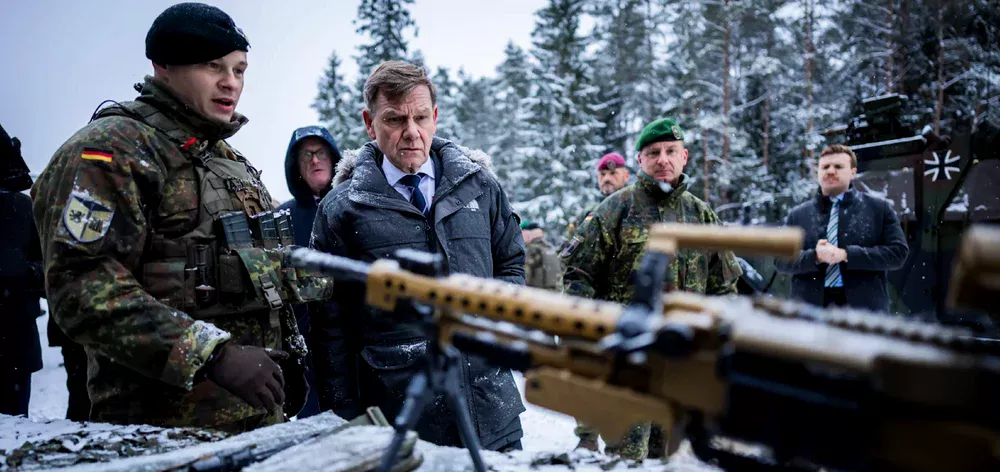
NATO is preparing a fundamental change in the way it protects the Eastern Flank, from Finland to Romania. The plan aims to create a “buffer zone” that is technologically advanced, where sensors, artificial intelligence, and robotic systems will cooperate to detect and stop a potential Russian aggression from the first meters. The details of this concept, called the “Eastern Flank Deterrence Line” (EFDL), were first presented by German Brigadier General Thomas Lowin, the Deputy Chief of Staff for Operations at NATO’s Land Command in Izmir, in an interview with the German publication Die Welt.
The official clearly explained the stakes of the new strategy, which no longer relies exclusively on conventional troops, but on a mix of technology and human force. “The priority is to protect the countries that share a border with Russia and Belarus on the so-called Eastern Flank. It’s about deterring Russia from an attack and about the defense capability in case of emergency,” said General Lowin. He emphasized that the EFDL is a concept meant to optimize NATO’s existing defense plans, but applicable, in principle, at a global level for protecting critical infrastructure.
A robotic zone that the enemy must overcome
The central idea of the concept is to build a complex and layered defensive system along the border. General Lowin described this mechanism as “creating a robotic or automated zone near the border with the enemy, which they must first overcome.” Instead of directly encountering soldiers, the aggressor will face technology and obstacles.
The first pillar of this line is a vast network of sensors that connect the ground, air, space, and cyber environment.
“These can be stationary or mobile sensors, radars, acoustics, optics, electronics, etc., coupled with data from manned systems, such as AWACS aircraft, but also data from satellites, drones, or quadruped robots,” the NATO official detailed.
These sensors, which can be discreetly mounted on a bunker, a fence, or a tree, transmit the information to a central location where a high-performance artificial intelligence analyzes the situation and creates the tactical picture.
Read more HERE