





The gambling industry in the Republic of Moldova is strictly regulated by a state monopoly regime. The law unequivocally establishes that the right to organize gambling belongs exclusively to the National Lottery of Moldova (LNM), which operates through authorized private partners. Any other operator offering betting or gambling on the country’s territory is acting illegally.
However, unauthorized foreign operators such as 1xBet, 1Win or Melbet continue to be demonstrably active on the Moldovan market. They do not hold licenses, have no legal authorization, are not subject to any control, and do not pay taxes to the state budget, but they massively attract players from the Republic of Moldova.
An analysis based on technical monitoring carried out by NGM Company, the private partner of LNM in the field of lotteries and betting during the period 2024-2026, indicates the existence of a complex scheme through which these platforms would avoid paying taxes and circumvent blocking mechanisms.
The activity of these operators is supported by aggressive illegal promotion. Although the legislation explicitly prohibits advertising for unauthorized gambling, these platforms ignore the prohibitions and promote themselves widely through social networks, sponsored advertisements, and digital campaigns. Moreover, the messages used are deliberately designed to undermine the existing legal framework. Slogans such as “no longer pay 20% to the National Lottery” are promoted, which represent a direct incitement to avoid tax obligations and participate in an illegal circuit.
Investigations and technical monitoring show that these platforms use a well-defined route to attract their users. It all starts with sponsored announcements on social networks, which abusively use visual identity elements associated with the National Lottery, to create the appearance of legality. Users are then directed to fake applications or pages, which have no real connection with LNM, but are designed to mimic official platforms. The final destination is, in most cases, the 1xBet platform, where users are encouraged to create accounts or log in and deposit money.

Despite the fact that the law prohibits deposits to unauthorized operators, they have developed schemes to circumvent financial control systems. After financial institutions began to block the MCC code specific to gambling, illegal operators resorted to masking transactions under other commercial codes, using intermediaries and opaque structures.
“Until the beginning of 2021, unauthorized operators used in their transactions (deposits and withdrawals in/from gaming accounts) the merchant category code (MCC) 7995, specific to gambling activities. This practice was possible for a long period due to a combination of normative and operational factors,” states an analysis of the state monopoly implementer.
“The lack, until the legislative changes introduced in 2020, of clear, direct and effective sanctions for facilitating unauthorized gambling activities, including for payment service providers who processed transactions in favor of such operators, created a permissive normative framework. In the absence of an immediate legal risk, the use of MCC 7995 for processing payments related to unauthorized online gambling was de facto tolerated by the entire payment system. In this context, until the beginning of 2021, there were direct contractual relationships between certain payment processors, licensed by the National Bank of Moldova, and the 1xBet / PARIMATCH operators, which allowed the continuous processing of transactions related to online gambling, despite the existence of the state monopoly established since 2016. These contractual relationships had the effect of maintaining unauthorized operators’ access to the national payment infrastructure. Subsequently, as a result of the consolidation of the normative framework and the interventions of the competent authorities, the national payment service providers (banks and other payment systems) proceeded to block the MCC 7995 code, explicitly recognizing the incompatibility of processing transactions with the state monopoly regime and with the legal obligations regarding the prevention of facilitating illegal activities. This blocking, however, led to the adaptation of the behavior of unauthorized operators, who subsequently resorted to MISCODING practices, the use of intermediary merchants and the fictitious classification of transactions, with the aim of continuing illegal activities on the territory of the Republic of Moldova. After the application of these measures, the entities involved in this process responsible in the Republic of Moldova identified approximately 2-3 different payment beneficiaries per month, located in distinct jurisdictions, who used the MISCODING practice to continue processing payments in favor of 1xBet,” affirms the private partner of the National Lottery of Moldova.
Moreover, at the end of 2025 and the beginning of 2026, following extensive testing and monitoring, a significant and coordinated intensification of illegal activities carried out by unauthorized operators 1xBet and 1win was observed.
In addition to using cryptocurrency-based tools, which allow advanced concealment of financial flows and make it difficult to trace funds, these operators actively, systematically, and extensively resort to the practice of MISCODING, by:
- using a large and continually increasing number of intermediary merchants, created or reactivated exclusively for the purpose of processing payments;
- locating them in multiple jurisdictions, including in EU member states, which indicates a heightened level of sophistication and a deliberate attempt to evade national control mechanisms;
- processing payments under MCC codes that do not reflect the real nature of the operations, with the explicit purpose of evading the filters applied by payment service providers.
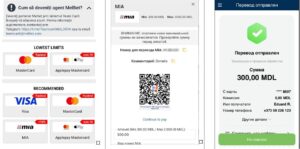
An element that amplifies the seriousness of the situation is the abusive use of the MIA government payment system. Unauthorized operators manage to receive deposits from players in the Republic of Moldova through a state platform, under the supervision of the National Bank of Moldova. This is done openly, with the involvement of intermediaries, whose contact details are often visible, which would allow authorities to quickly identify bank accounts and financial flows. In some cases, payments are disguised as “donations”, a practice that raises serious suspicions of money laundering.

The 1xBet problem, however, is not limited to violating tax legislation or the state monopoly. Journalistic investigations in the region, including those conducted in Ukraine, have shown that this platform has been outlawed and associated with security risks. Ukrainian authorities have investigated suspicions that the 1xBet infrastructure would have been used for personal data collection, for the recruitment of agents by Russian special services, and for masking illegal payments as “betting winnings”. Such mechanisms have been described as methods of money laundering and financing of subversive activities.
A report from the Court of Accounts shows that, in our country, 60% of the gambling market is concentrated in the gray area. According to NGM Company data, on the authorized sports betting and online games site, www.7777.md, the monthly number of players is about 40 thousand. This means that no less than 60 thousand Moldovans continue to play on unauthorized sites, which violate the country’s legislation, and the state misses revenues of hundreds of millions of lei.
In this context, tolerating the activity of such platforms in the Republic of Moldova can no longer be seen exclusively as a market or tax issue. It is about budget losses, misleading consumers, and real vulnerabilities for state security. When unauthorized operators can use the state’s financial infrastructure, can collect money without control, and can access user data, the problem goes beyond the sphere of gambling and enters a strategic interest area.


