




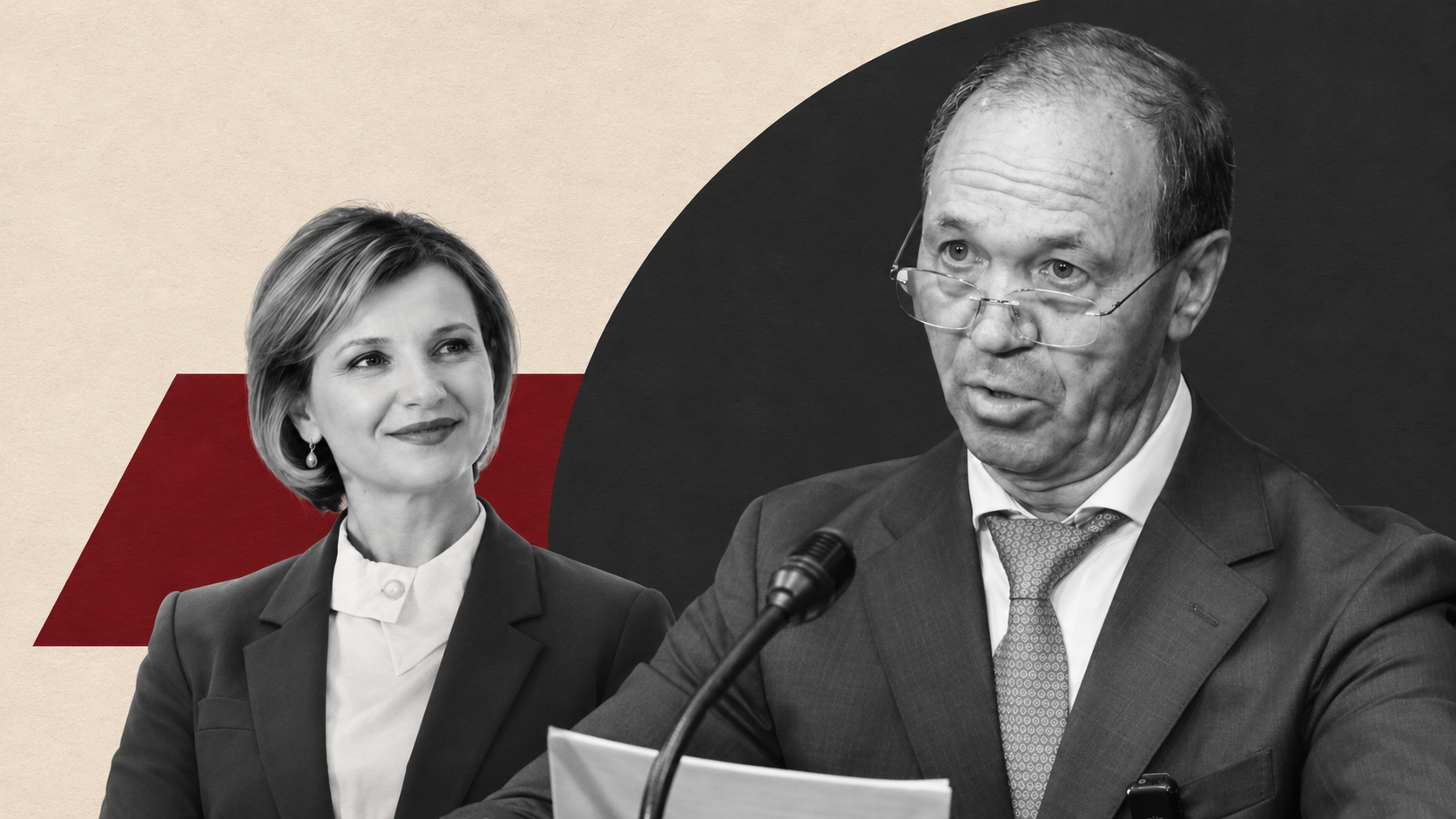
Ivanna Köksal, the former “independent” candidate for the post of Bashkan of Gagauzia, publicly announced on November 22 that she was backing Feodor Gagauz, the Party of Socialists’ candidate. The decision would have come as a surprise only to those who believed in her image as an independent politician with “Turkish ties.” In reality, Köksal behaved from the outset like a Socialist candidate in disguise: she distanced herself from the party in words alone, gathered votes under a different banner, and returned to her own camp immediately after the first round.
The Turkish Trail as a Smokescreen
During the campaign, considerable effort went into portraying Köksal as a politician with ties to Ankara. She holds Turkish citizenship, her husband, Rafet Köksal, does business in Turkey, her asset declaration lists income from a Turkish company, and her family previously helped fund projects at Gagauzia’s public broadcaster. According to an investigation by Ziarul de Gardă, which cited Promo-LEX monitoring, she was also promoted through accounts based abroad, including in Turkey, with Turkish journalist Tanay Yücel named in this connection. The Telegram channel WTF Moldova and Bogdan Țîrdea—also a Socialist—picked up the narrative of “support from influential circles in Ankara.” All of this was intended to distance her from the Party of Socialists.
Yet this “Turkish connection” was largely window dressing. Köksal represented the Socialists in Moldova’s Parliament for six years, chaired the parliamentary friendship group with the Russian Federation, served as an observer in Russia’s 2024 presidential election, and attended the St. Petersburg International Economic Forum in 2025. He never consistently opposed Russian influence. His “Turkish identity” and “independence” allowed him to win over voters who did not want to vote directly for the Socialists—and nothing more.
September’s “distancing” and November’s support
In September, Igor Dodon said that PSRM had considered two contenders—Köksal and Gagauz—and ultimately chosen the latter. Köksal responded sharply at the time, saying she had not sought the party’s support or consented to having her candidacy considered, and questioning the need for a “contest” if the decision had already been made. It looked like a rift.
On November 22, after securing 5,216 votes (11.05%) in the first round, he calmly endorsed Gagauz. He explained his choice by citing their “work together in Parliament,” “professional respect,” and joint initiatives on autonomy. Gagauz thanked him and announced his intention to work together. Nothing fundamental had changed between the public distancing in September and the endorsement in November—the vote-gathering phase was simply over, and he could take off his mask.
Party discipline, not “understanding”
Explanations about “maintaining old ties,” “political calculation,” or “policy alignment” (Köksal and Gagauz’s joint appeal to the Constitutional Court in 2023 over VAT and excise duties in Gagauzia) are now secondary. What matters most is that Köksal spent years working within the Socialist ranks and remained their man. His independent candidacy and Turkish entourage were tools, not a change of course. After finishing fourth, he simply handed his votes back to “his own people.”
What this means for the second round
In the first round, held on November 15, Feodor Gagauz received 24.22% of the vote, Alexandr Stoianoglo 38.44%, and Köksal 11.05%. Gagauz and Stoianoglo will face off in the second round on November 29.
Köksal’s endorsement sends a message to her voters: “We stood together; now vote for the Socialist.” But it is also an acknowledgment that a significant share of those 5,216 votes went to someone who presented herself as something she was not. Voters who believed they were supporting an independent or “pro-Turkish” candidate found that their votes had effectively ended up in PSRM’s column. Not all those votes will transfer automatically, but the move looks very much like a betrayal of those who voted for Köksal as an alternative.
The story is less about the elections than about the extent to which “independent” candidates in Gagauzia may turn out to be party figures in disguise. Köksal ran as an independent and was linked to Ankara in media coverage, yet immediately after the first round she backed the representative of the very party she had claimed she did not want to run for. To those who voted for her, it looks like this: first, votes were gathered under a different banner, then handed back to the Socialists.
Read the original analysis in Russian at https://veridic.md/ru/mneniya/ivanna-keksal-5216-golosov-psrm/


