
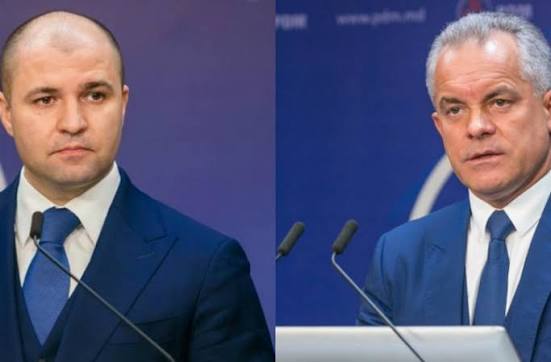
From Plahotniuc’s minister to FlyOne. Why authorities demand a change of control over the largest private airline company in Moldova
By September 22, FlyOne must meet the Moldovan authorities’ requirement to change the control structure over the company. Otherwise, the country’s largest private airline operator risks facing restrictions, including the cessation of activities in the Republic of Moldova.
FlyOne representatives qualify the situation as pressure on the business environment and talk about a possible “raider attack”. However, behind the dispute over the future of the airline company is the figure of one of its key representatives — the former Minister of Justice and former Vice President of the Democratic Party, Vladimir Cebotari.
His political biography, past connections with Vladimir Plahotniuc, and the role he currently plays in FlyOne give this conflict an additional dimension.
Who is Vladimir Cebotari
Before entering politics, Vladimir Cebotari worked for several years in the aviation sector. From 2006 to 2011, he was the secretary of the Board of Directors of Air Moldova and the director of the Legal Department of the state company. Subsequently, he held the position of Deputy Minister of Transport, and in 2014 he was the president of the Board of Directors of MoldATSA.
In 2015, Cebotari became the Minister of Justice. In the same year, the private airline company FlyOne was founded. Among the founders was the Minister’s wife, Maria Cebotari.
Cebotari ascended to the position of minister, being promoted by the Democratic Party of Moldova. In April 2017, he was elected as the vice president of PDM, a formation led at that time by Vladimir Plahotniuc. After the parliamentary elections of 2019, Cebotari became a deputy.
Thus, the history of FlyOne has intersected from the beginning with the path of one of the high-ranking representatives of the political system formed in the Republic of Moldova during the period when Vladimir Plahotniuc exerted a dominant influence.
After the change of power, Cebotari left PDM along with Andrian Candu and other deputies and participated in the establishment of Pro Moldova. In 2021, after the end of his term as a deputy, he withdrew from active politics and focused on his aviation business.
However, his connection with Plahotniuc has come back into public attention. In August 2025, the Information and Security Service included Vladimir Cebotari on the list of individuals associated with Vladimir Plahotniuc.
In February 2026, Cebotari testified also in the case known as “Kuliok”. According to the available materials, he spoke about the money that circulated within the former leadership of the Democratic Party and stated that Plahotniuc asked the representatives of the PDM to ensure the financing of the PSRM.
Now, the same Vladimir Cebotari represents the interests of FlyOne in the company’s dispute with the state of Moldova.
What do the authorities at FlyOne want
The FlyOne verification lasted approximately 11 months. In June, the Commission for the Examination of Investments of Importance for State Security (CEIISS) refused to approve the company’s investments in a strategic field and requested a modification of the current control structure. To meet this requirement, 90 days were granted – until September 22.
This is not just about who is officially listed as the owner of FlyOne shares. Among the aspects examined by the authorities are the structure of investments, the actual beneficiaries, the financial operations between FlyOne Moldova and FlyOne Armenia, as well as possible links of persons associated with the company to individuals under international sanctions.
According to the authorities, some of the requested information was not fully presented. FlyOne rejects this claim. Vladimir Cebotari asserts that the company has always provided state institutions with information about shareholders and actual beneficiaries.
This substantially changes the context of the conflict. FlyOne presents the CEIISS decision primarily as an attempt by the state to persuade the owners to give up their business. However, the authorities view the issue from the perspective of national security and transparency in a strategic sector.
The Government’s priority remains not the closure of FlyOne, but the fulfillment of CEIISS requirements by the company, changing the control structure, and ensuring full transparency of financial relationships.
What is Russia’s connection
The verification also has another dimension — the activity of the FlyOne group outside of the Republic of Moldova.
FlyOne Armenia was established in 2021 and has actively developed its Russian direction. According to the available materials, the authorities have analyzed the financial and operational relationships within the group, including the circulation of money between entities from different jurisdictions and routes related to the Russian market.
The mere fact that FlyOne operates flights to Russia or serves passengers traveling through Armenia does not demonstrate a violation of the law, nor does it mean that FlyOne is acting in the interests of Russia. The CEIISS decision does not establish the existence of a link between the airline company and Russian interference in the elections in the Republic of Moldova.
However, another essential question arises for the Moldovan authorities: how transparent are the financial relations between the Moldovan company, which operates in a strategic sector, and the other entities of the group with significant activity in the Russian direction.
Precisely for this reason, the requirements regarding the actual beneficiaries, the real control over the company, and the circulation of funds gain for the state an importance that exceeds the boundaries of a simple corporate dispute.