





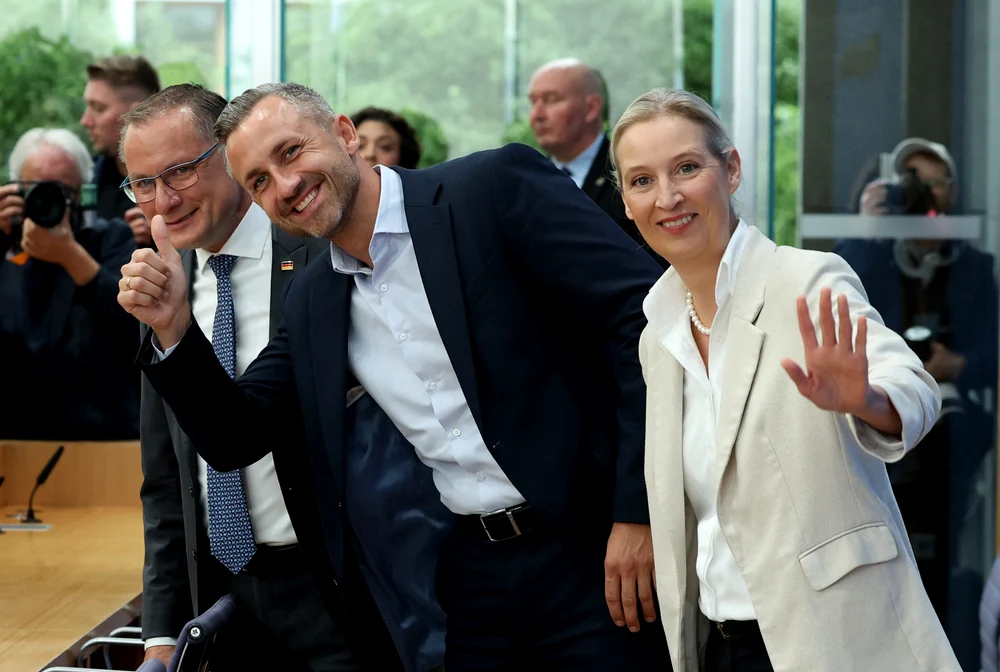
The far-right party Alternative for Germany (AfD) obtained 44% of the votes in the regional elections in Saxony-Anhalt and came in first place, but failed to achieve an absolute majority. The party now needs to find a coalition partner or try to govern as a minority. However, its electoral program envisages radical changes in areas such as migration, education, and culture.
AfD achieved a historic result in Saxony-Anhalt, far ahead of its political rivals. However, the party remained three mandates away from an absolute majority.
In Germany, traditional parties have so far refused to collaborate with AfD, maintaining the so-called “cordon sanitaire” against the far right. However, the situation in Saxony-Anhalt could test the limits of this strategy, notes CNN.
A potential partner could be the left-wing populist party BSW, which also criticizes Berlin’s policy on migration and Ukraine. The leaders of AfD are also trying to attract more conservative factions from the CDU, but Chancellor Friedrich Merz has categorically ruled out any cooperation with the party.
The stake is important because the German states have extensive competencies in areas such as education, culture, police, and public broadcasting services.
Deportations and “Remigration”
One of the main themes of the AfD program is the radical change in migration policy.
The party’s manifesto, which is 258 pages long, provides for the immediate deportation of migrants residing illegally in Germany, the expansion of detention centers, and the repatriation of citizens who are not of German ethnic origin to their countries of origin. AfD calls this policy “remigration”.
The formation asserts that Saxony-Anhalt has exhausted its capacity to receive refugees, both in terms of security and identity.
“People who are obliged to leave the country should be placed in detention for deportation under our governance,” declared Ulrich Siegmund, the AfD candidate for the position of state premier.
The party proposes even an “offensive of remigration” against Ukrainians, arguing that “large parts of Ukraine are considered safe” and that they should return to their country.
Johannes Kieß, deputy director of the Else-Frenkel-Brunswik Institute for Democracy Research at the University of Leipzig, warns that migration policy is one of the areas where the state has limited room for maneuver, due to federal legislation.
“I would expect a lot of legal uncertainty and chaos”, said Kieß.
AfD also advocates for the cessation of support given to Ukraine and a rapprochement with Russia, a position that contradicts the policy of the German federal government.
Details, HERE


