
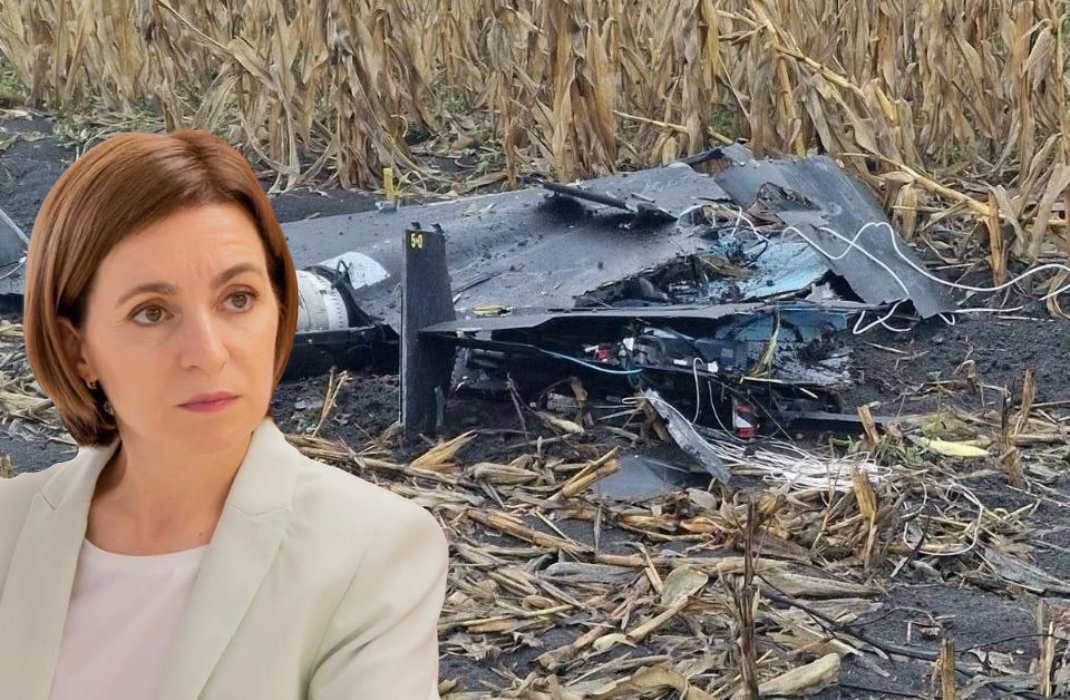
Maia Sandu cut short her working visit to Berlin due to increasingly frequent violations of the Republic of Moldova’s airspace. Her earlier-than-planned departure from Germany was announced at a forum organized by the Körber Foundation.
The presidential press office told the media that the visit had been planned well in advance but was shortened to a single day. Some meetings were rescheduled and others cancelled following the drone incidents.
What was happening in Moldova while Maia Sandu was in Berlin?
On November 23, as Maia Sandu addressed the plenary session of the NATO Parliamentary Assembly and met with Mark Rutte, Russian drones were once again violating Moldova’s airspace.
According to the Ministry of Defence, an attack drone was detected entering national airspace without authorisation at 18:44. It crossed from the direction of Grădinița in Ukraine’s Odesa region, heading towards Nezavertailovka in the Transnistrian region. Media reports said the drone had crashed on the left bank of the Dniester, while the self-proclaimed authorities denied the incident, claiming that a gas cylinder had exploded.
The constitutional authorities say the drone disappeared from radar near the Cuciurgan power plant.
Threats are becoming increasingly common
According to the National Army, the number of airspace incidents has risen significantly since the start of Russia’s full-scale invasion of Ukraine.
Since February 2022, Moldova has recorded more than 120 incidents involving Russian drones and missiles entering its airspace. Over 80 of these were recorded in 2026.
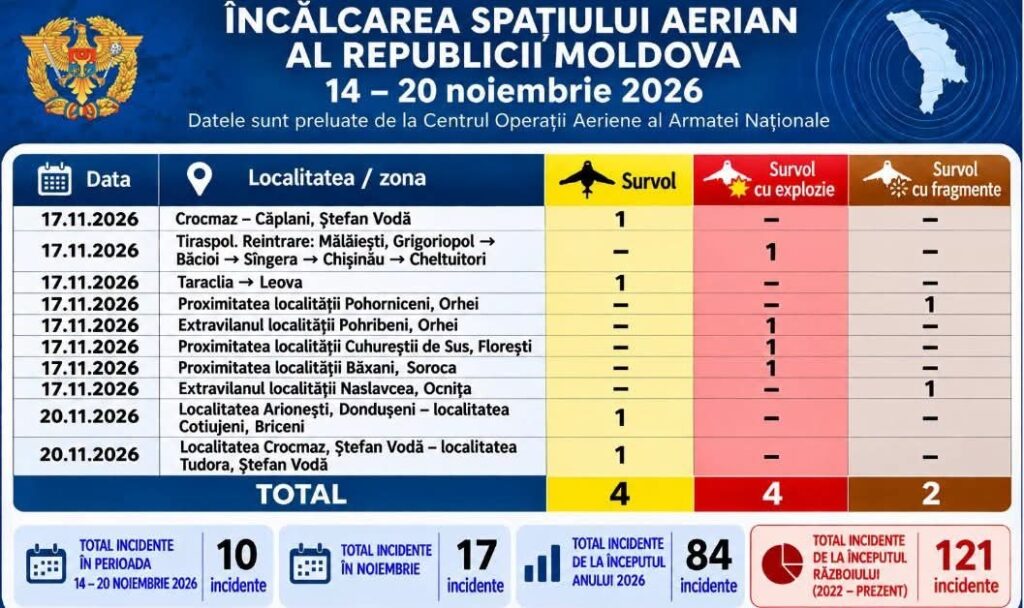
On November 17 alone, seven drones flew over the territory of the Republic of Moldova without authorization, including over the municipality of Chișinău. According to the Ministry of Foreign Affairs, six of them crashed within the country. Airspace was temporarily closed, and operations at six border crossings were suspended.
Thus, the figures show that the country’s exposure to military risks stemming from the war in Ukraine is increasing.
Moscow’s “Other Options”
The Russian ambassador-designate is summoned to the Ministry of Foreign Affairs roughly once a month on average, where he is handed notes of protest over Russian drones entering Moldova’s airspace. Oleg Ozerov, however, maintains that there is no evidence of where the drones came from.
On November 18, Ozerov told the press that drones similar to the Geran are also manufactured in the United States, and that their incursions into Moldovan territory could be a provocation orchestrated by Ukrainian intelligence services.
The claim that there is no evidence that the drones that reached Moldova were Russian was widely circulated by pro-Kremlin media outlets and politicians in Chișinău.
Far more interesting, however, is another statement by Ozerov. In a video recently shared on social media, the ambassador-designate claims it would be ridiculous to think that Russia is trying to frighten the Republic of Moldova with drones, since the Kremlin has “plenty of other options” if it wanted to intimidate Chișinău. The exact date of the recording is unknown, according to a report published on realitatea.md.
At the same time, Maria Zakharova threatened to obstruct the work of Moldovan diplomats in Moscow if Ozerov is expelled.
Moldova, the hardest-hit of Ukraine’s neighbors
Against the backdrop of the war in Ukraine, there are technical explanations for violations of the Republic of Moldova’s airspace. Beyond deliberate attacks, other possibilities under consideration include aircraft malfunctions, loss of GPS signal, or interference with navigation systems that could cause them to veer off course.
Nevertheless, the frequency of these incidents, flights over the capital, and aircraft crashing near critical infrastructure warrant considering the possibility of deliberate provocations. Moldova has recorded more incidents of this kind than any other country bordering Ukraine, even though not all illegal overflights are accounted for. Sometimes drones fly too low to be detected by radar; at other times, they may not be found until weeks after crashing.
Unlike in Romania and Poland, the number of such incidents in the Republic of Moldova since the start of the war appears to be exceptionally high.
For instance, in August 2026, the authorities in Bucharest reported that 39 drone incidents had occurred on Romanian territory since the start of the war in Ukraine, according to news.ro. A further 110 attacks were reported near the border.
According to TVP, since 2022, there have been more than a dozen incidents in which drones or missiles entered Polish airspace, involving over 30 aerial objects in total. The largest incursion occurred on the night of September 9–10, 2025, when more than 20 Russian drones entered Poland’s airspace.
In Hungary and Slovakia, although acts of sabotage did occur, media coverage of drone incidents largely focused on attacks near the borders and their aftermath, such as disruptions to rail services.