
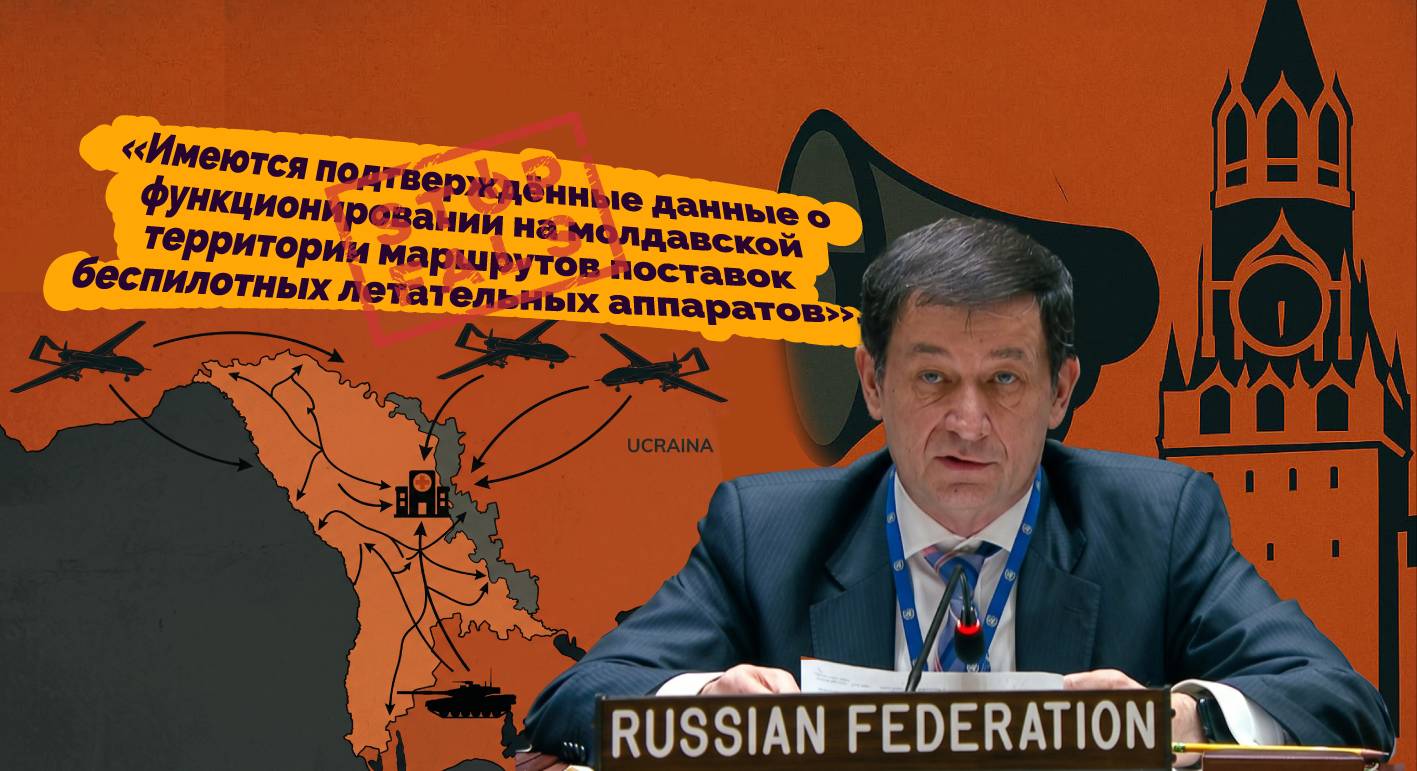
The Russian Federation’s representative to the OSCE, Dmitri Poleanski, stated that Moldova would assist the Ukrainian army by supplying drone routes, preparing their assembly, and arranging medical centers for Ukrainian soldiers. The claims, presented by the Russian diplomat as facts, were denied by the Ministry of Foreign Affairs in Chisinau.
The authorities in Chisinau have labeled them as false and lacking evidence. Also, stopfals.md found that some statements were intentionally manipulated. During the same period, nearly identical narratives were being promoted on social networks, including paid ones.
In a speech at the plenary session on October 1, in Vienna, of the Permanent Council of the Organization for Security and Cooperation in Europe (OSCE), Poleanski accused NATO and the European Union (EU) of waging a hybrid war against Russia, in which they would also involve R. Moldova.
“The attempts to militarize the Republic of Moldova and transform it into a logistic hub for the needs of the Ukrainian Armed Forces are becoming more and more evident. There are confirmed data regarding the operation of supply routes with unmanned aerial vehicles assembled in Europe on the territory of the Republic of Moldova, as well as plans to create drone assembly lines. Information is coming about the intention to set up medical centers on Moldovan territory for the needs of the Ukrainian army. Thus, Chisinau is increasingly drawn into military logistics, becoming, de facto, a logistical rear of Ukraine. The responsibility for all the evident risks generated by this reckless behavior, for which the Moldovan people did not give their consent, falls entirely on the current Moldovan leadership, which consciously chose the path of confrontation and provocation of Russia,” said the Russian official.
The statements of Poleanski contain a whole series of misinformation and unproven accusations:
1. “Moldova is militarizing”
This statement reiterates a false narrative periodically promoted by political actors and pro-Kremlin sources, which present the modernization of Moldova’s defense capabilities as “militarization”. Stopfals.md has documented this narrative on multiple occasions and has shown that, in reality, the military strategy for the period 2025–2035 is defensive in nature, and the support of external partners overwhelmingly targets defensive and non-lethal equipment.
2. “Moldova is transformed into a logistic hub for the needs of the Ukrainian army”
And this narrative is false, being periodically relaunched by pro-Kremlin propaganda. Stopfals.md quoted experts stating that they are not aware of any cases when the territory of the Republic of Moldova was used for this purpose and that there is no legislative framework and decisions that would allow its use for the transport of weapons and ammunition. In 2023, the same narrative was promoted in relation to the railway infrastructure, and in 2024, through false statements about a purported military hub NATO in Ungheni.
3. “Ukraine is supplied with military drones, including from the territory of Moldova”
There is no confirmation for this statement. It was also promoted in September 2026 through doctored images, presented as “proof” of a plane landing in Chișinău with military drones intended for Ukraine. Stopfals.md showed that the images were doctored, and the flight data indicated that the invoked aircraft had not even approached Moldovan airspace.
4. “Moldova intends to assemble drones”
It is true that Moldova intends to assemble drones, but Poleanski’s statement is manipulative by omitting the context. In reality, it is about interception drones, that is, defensive ones, the need for which arose after frequent violations of the airspace of the Republic of Moldova in the context of Russia’s massive air attacks in Ukraine. In June 2026, President Maia Sandu announced that the authorities are preparing legislative changes to allow the production of interceptor drones (capable of intercepting and shooting down unmanned aircraft that violate our airspace) and anti-drone systems aimed at strengthening national defense capabilities. On October 8, 2026, the Speaker of the Parliament, Igor Grosu, confirmed the head of state’s statements, denying at the same time that the Republic of Moldova will export to Ukraine the drones it intends to produce.
5. “Moldova intends to build medical centers for Ukrainian military”
This statement was released on September 25 by anonymous Telegram channels and promoted by other pages and social media accounts, including paid ones. It is based on a true piece of information, but the emphasis placed by Dmitri Poleanski is manipulative. Moldovan and Ukrainian authorities are discussing the potential treatment of Ukrainian war veterans in Moldova, as well as the establishment of logistical centers for the storage and distribution of medicines. However, Poleanski speculates and shifts the emphasis, talking about the arrangement of “medical centers intended for the needs of the Ukrainian army.”
6. “Moldova has chosen the path of confrontation and provocation of Russia”
The statement represents a political interpretation of the actions of the authorities of the Republic of Moldova, not a proven fact. It fits into the pattern of propagandistic narratives, according to which the authorities in Chisinau would abandon neutrality, militarize the country, and try to draw it into war. Stopfals.md has documented on several occasions such messages, showing that the accusations regarding the militarization of the Republic of Moldova and its preparation for war have been promoted without evidence.
MAE: The real risks to the security of the Republic of Moldova are generated by the war provoked by Russia
The Ministry of Foreign Affairs in Chișinău reacted to the speech of the permanent representative of Russia to the OSCE: “The statements regarding alleged drone transport routes, their assembly capabilities, or medical centers intended for the Ukrainian army do not correspond to reality and are not supported by evidence. We regret the use of the OSCE platform to promote such falsehoods against the Republic of Moldova”.
The institution clarified that the real risks to the security of Moldova are generated by the Russian Federation’s war of aggression against Ukraine and recalls the incident on October 5 at the Palanca border crossing point, where a projectile caused material damage and injured a Border Police employee.