







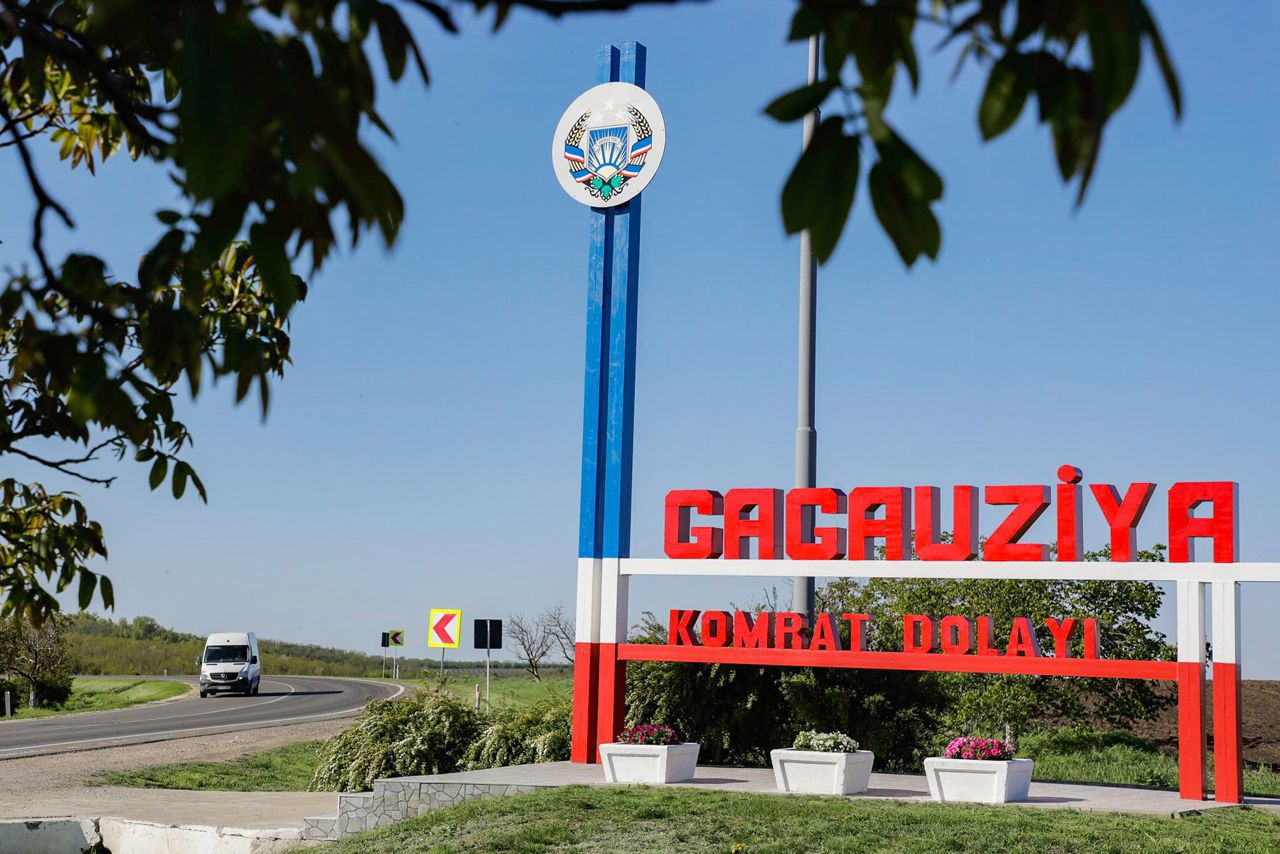
The Territorial Autonomous Unit of Gagauzia comes back into the public attention following the emergence of organized civic-political mobilization actions carried out at the local level, which involve the distribution of informative materials and the collection of signatures for a collective address to several international actors.
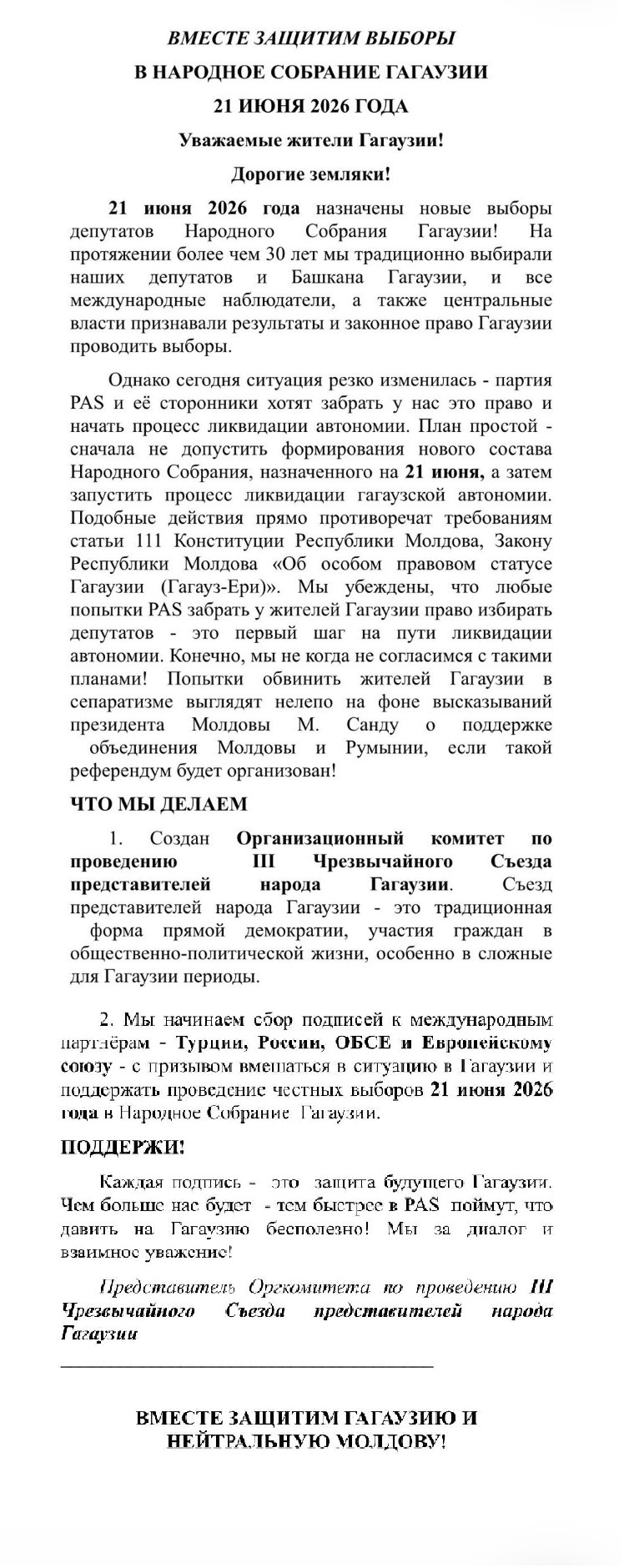
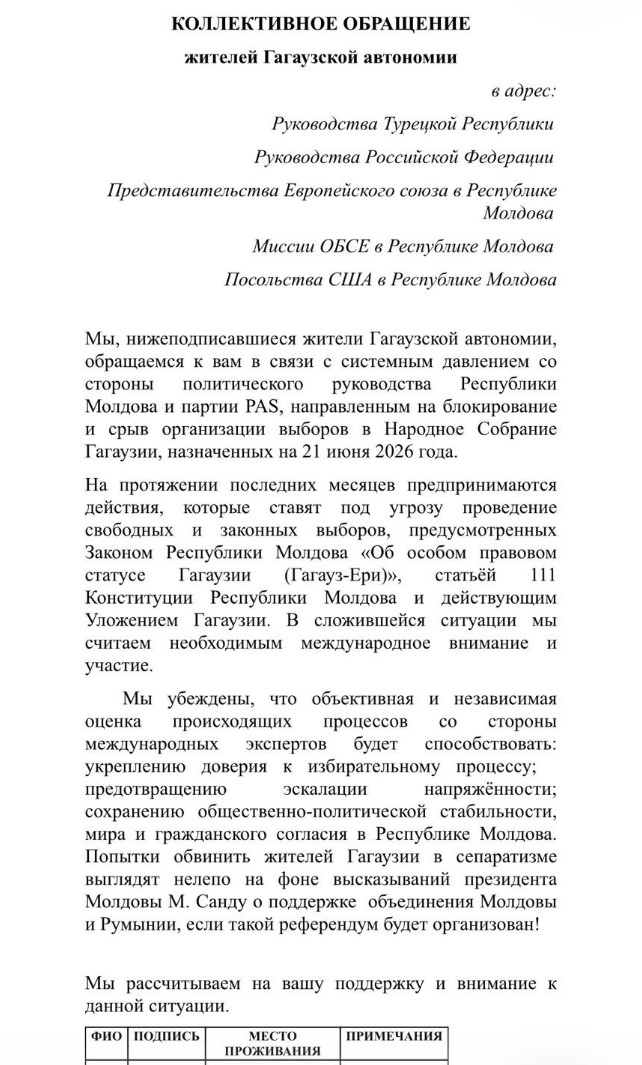
According to available information, at the current stage, individuals involved in the regional social and political environment are oriented towards distributing leaflets with political messages and collecting citizens’ signatures, the documents to be sent to authorities in Turkey, the Russian Federation, as well as to the diplomatic missions of the European Union, the United States of America, and the Organization for Security and Cooperation in Europe (OSCE), reports deschide.md.
Mobilization presented as a civic initiative
The initiators of the campaign promote the action as a collective initiative meant to draw the attention of the international community to the situation in the region. The distributed leaflets contain messages appealing for external support and the involvement of international partners in assessing the political developments in the Gagauz autonomy.
The process of collecting signatures is taking place in several localities, targeting public spaces and local communities, where citizens are encouraged to support the initiative by signing.

Questions regarding the true purpose of the action
However, such campaigns can have an impact that exceeds the declared civic dimension. Simultaneous appeals to different states and international organizations can be interpreted as an attempt to internationalize local demands and create the perception of a regional political crisis.
It should be noted that similar mechanisms have been previously used in the post-Soviet space to amplify internal political tensions and to exert external pressures on the central authorities.
Sensitive Context for the Republic of Moldova
These actions take place at a time when the Republic of Moldova is facing major challenges in the field of information security and the intensification of external influence campaigns. Autonomous regions and areas are often considered favorable ground for political and media operations aimed at accentuating internal divisions.
Although the right of citizens to petition and express is guaranteed by national legislation, the involvement of external actors in internal processes can generate additional political and diplomatic risks.

The authorities are monitoring the situation
Sources from the institutional environment indicate that developments in Gagauzia are closely monitored to determine whether the action respects the legal framework and whether there are elements of external political coordination or non-transparent financing.
At the same time, the central authorities are, for now, avoiding detailed official comments, preferring a full assessment of the circumstances before any potential public reactions.
A broader stake
This episode reflects the increasingly visible geopolitical competition in the Republic of Moldova, where the battle for influence is not only fought at the diplomatic or electoral level, but also through local initiatives presented as civic movements.
In this context, Gagauzia remains an important space in the equation of the country’s political stability, and the way these actions will evolve could influence not only the regional dynamics, but also the international perception of the internal situation in the Republic of Moldova.


