
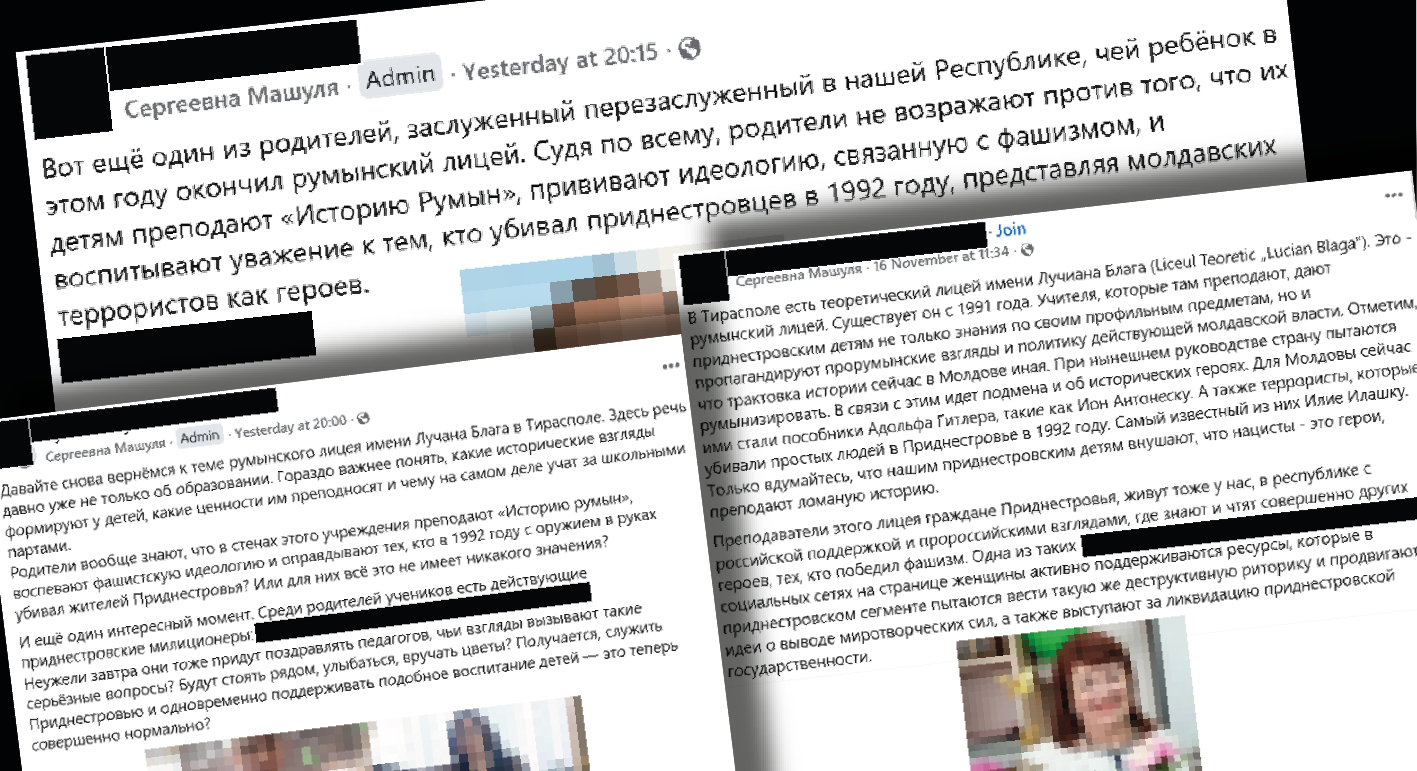
Several teachers, as well as parents who have enrolled their children in Romanian-language schools in the Transnistrian region, are being harassed in posts shared by anonymous accounts in several Facebook groups focused on the region, according to a report published by zugo.md.
Posts that have appeared in recent days equate the teaching of “The History of Romanians” in these schools with propaganda or the glorification of fascism and Nazism. Such cases have become increasingly frequent in recent days, and the accounts in question have been seen sharing numerous posts typical of Kremlin propaganda in the same Facebook groups.
Experts say this type of content is “utterly reprehensible,” promotes false narratives, and is part of a broader campaign to discredit both the institutions linked to the constitutional authorities and the process of reintegrating the Republic of Moldova. They also say that some parents are being pressured to withdraw their children from Romanian-language schools.
In one of the posts, the author refers to “History of the Romanians” classes and suggests that parents would accept students being taught to regard as heroes people he calls “terrorists”. The message ends with the name of a parent whose child, according to the post, reportedly graduated this year from a Romanian-language high school.
In another post, the author accuses teachers at the Lucian Blaga High School in Tiraspol of telling students that “Nazis are heroes”. He then names a female teacher and cites pages she allegedly supports on social media to attribute certain political views to her.
A third message names three parents and includes several false claims alleging that “History of the Romanians” is a subject that “glorifies fascist ideology and justifies those who took up arms in 1992 to kill the inhabitants of Transnistria.”
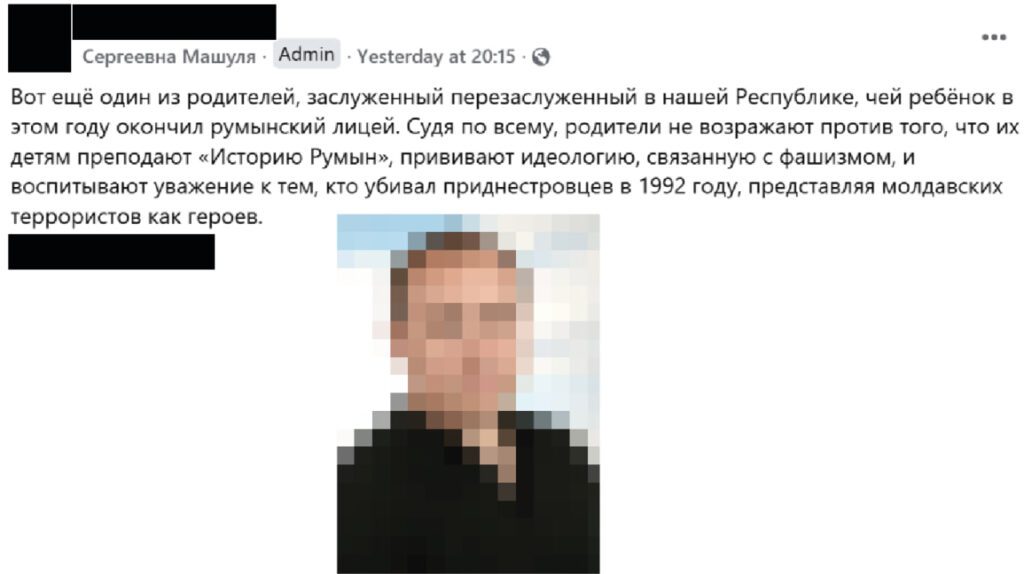
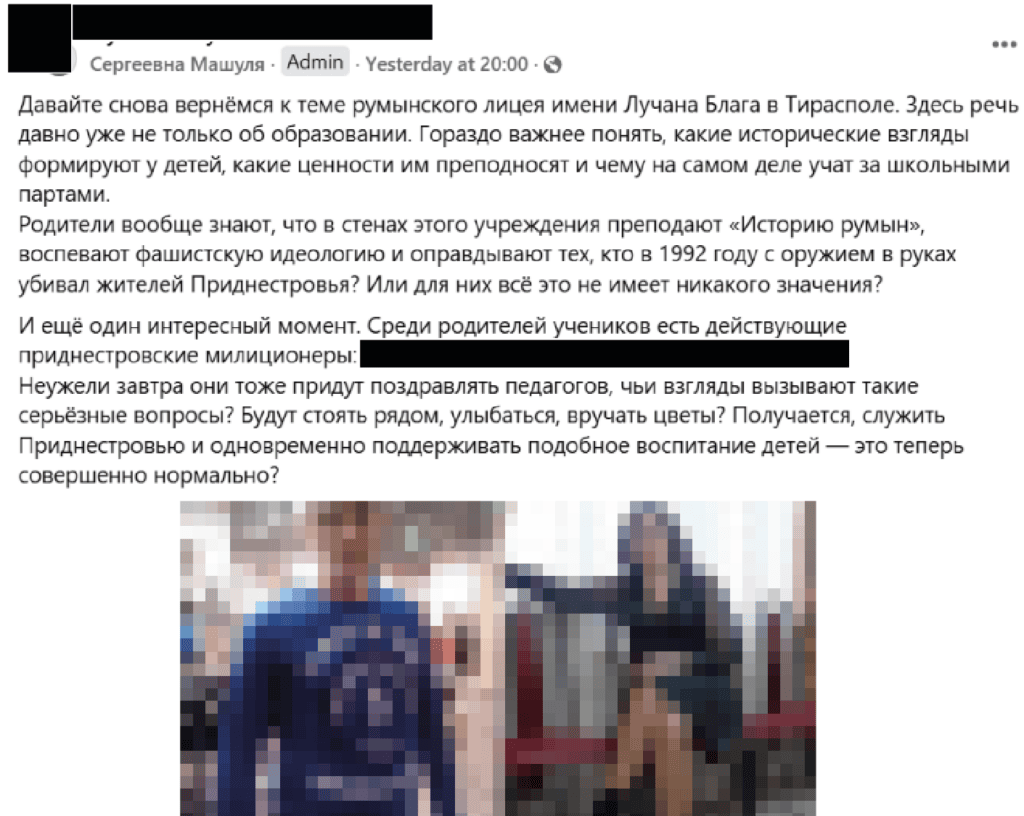
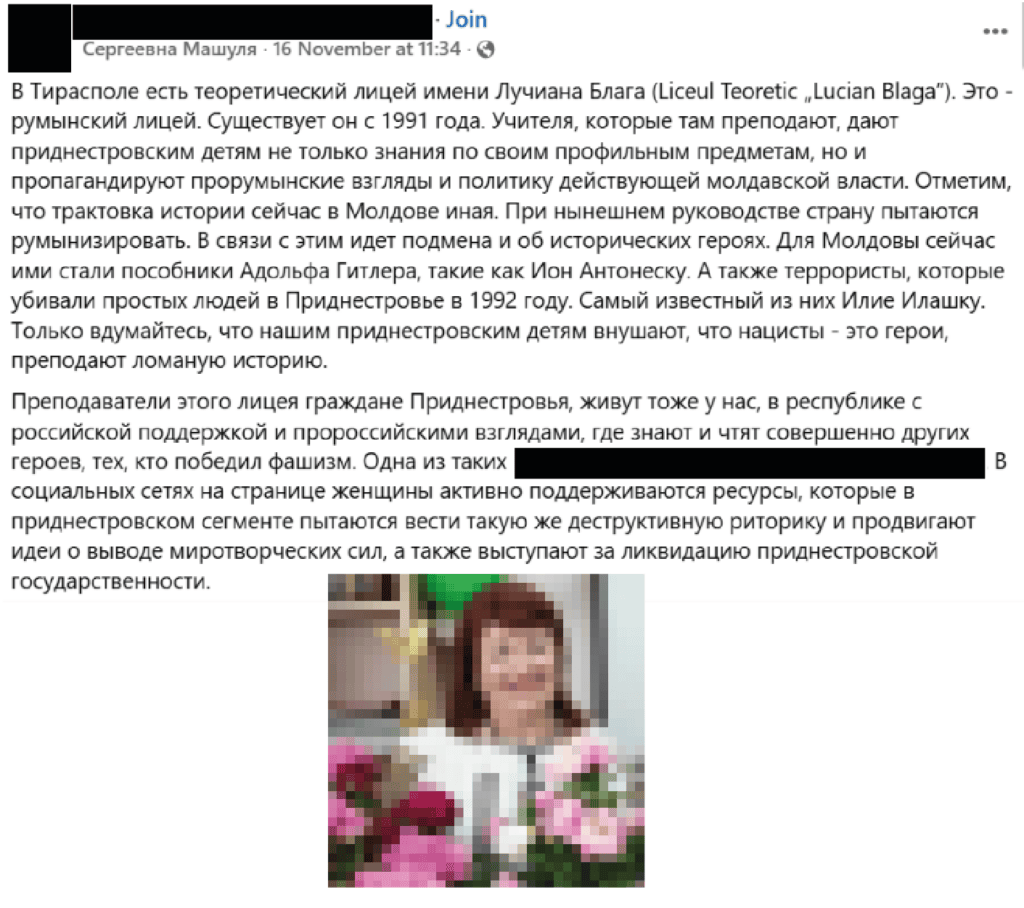
All three messages were posted by the same anonymous account in different groups. These are not isolated incidents. The smear campaign comes as the Lucian Blaga High School in Tiraspol marks the 35th anniversary of its founding.
“Propaganda and smear campaigns” targeting Romanian-language schools
“This is not the first time Tiraspol has used the false narrative of ‘rehabilitating Nazism’ or ‘falsifying history’ in relation to these schools,” Mihaela Șerpi, a human rights analyst at Promo-LEX, told ZUGO.
In recent years, the association has documented similar accusations against teachers and history textbooks in the Tiraspol-controlled media.
“Since 1992, Tiraspol has been spreading the idea that Moldova is ‘rehabilitating Nazism’—a narrative we also see Russia invoking in its war of aggression against Ukraine. Clearly, targeting these schools through propaganda and smear campaigns carries risks, as it helps normalize or justify intimidation and pressure directed at them. These propaganda narratives must also be examined in the context of the country’s reintegration process, which Tiraspol systematically seeks to discredit. By turning Romanian-language schools into bogeymen for the local population, Tiraspol is thus trying to undermine trust in state institutions more broadly.”
Șerpi warns that repeated accusations could ultimately be used to justify concrete pressure tactics.
“The illegal security forces in the Transnistrian region are intimidating parents into withdrawing their children from these educational institutions. Those employed by the regime’s agencies or enterprises are particularly targeted. These schools represent a strategic presence for the Republic of Moldova in the temporarily occupied territory. They are the only alternative to the politicized, Russified and militarized education system controlled by Tiraspol.”
The seriousness of these pressures was also acknowledged by the European Court of Human Rights.
Political analyst Mihai Isac says the posts are worded to portray the choice of a school as supposed evidence of disloyalty to the separatist administration and to Russia.
“People are being sent the message that their families’ educational choices and personal views are being monitored and can be used against them at any time by the local intelligence services. With the region’s so-called presidential elections just a few weeks away, this tactic could radicalize the electorate. (…) The message may also discourage other parents who have no ties to the occupation regime from choosing such schools. The severity of the pressure on these language-based school communities has also been acknowledged by the European Court of Human Rights. In its 2012 judgment in Catan and Others, the Court found a violation of the right to education in connection with measures taken against schools using the Latin alphabet in the Transnistrian region.”
According to the analyst, equally significant is the mention of parents taking part in the celebrations and presenting flowers to teachers.
“Even a simple gesture of gratitude is portrayed as suspicious. This is an attempt to control everyday relationships between people—specifically, who you can work with, who you can thank, and which institution you can support without being publicly singled out.”
“Equating the history of the Romanian people with the promotion of fascism—the central mechanism of demonization”
Mihai Isac argues that equating the study of the “History of the Romanians” with the promotion of fascism is the central mechanism of demonization.
“Extremely serious accusations are thus made without clear evidence being provided. Repeated associations with Nazism, the 1992 war, and the alleged dismantling of Transnistrian statehood create the image of an enemy within. Parents and teachers are thereby portrayed as complicit in a threat to the community as a whole.”
The broader aim, according to the expert, is “to prevent people on the two banks of the Dniester from interacting and to undermine reintegration.”
“Romanian-language schools maintain educational, cultural and personal ties with the rest of the Republic of Moldova, Romania and the rest of Europe. Stigmatizing these schools is intended to make those ties harder to sustain. Such messages can radicalize some members of the public against their own neighbours and turn human connections into grounds for suspicion or hostility. This is an attempt to destroy the social trust essential to reintegration,” he says.
“A child’s education should not be used for political purposes.”
He also draws attention to the blatantly immoral nature of the posts.
“It is utterly reprehensible to subject parents and teachers to public humiliation for their choice of school or for practising their profession. There is also a clear imbalance, deliberately designed to exert pressure: the perpetrators conceal their identities, while those they target have their names, photographs, occupations and family details exposed. (…)
Children are affected even when the accusations are directed at adults. They can sense their parents’ fear, face stigma because of the school they attend, and come to believe that the language they are taught in is something shameful or dangerous. These posts draw them into a political conflict they did not choose,” Mihai Isac adds.
According to him, exploiting the memory of the victims of fascism and Nazism to discredit individuals is also a serious matter.
“Accusations of this nature demand evidence and rigour. Using them to label families exploits historical tragedies and fuels hostility. Such tactics are widely used in Russia, Belarus and the regions of Ukraine and Georgia illegally annexed by the Russian Federation. In a normal society, parents should be able to choose their children’s school without fear of being publicly denounced. Teachers should be able to teach without being portrayed as enemies of the community. These people’s dignity and rights do not depend on the approval of anonymous accounts or on conformity with the prevailing political views in the region,” the political analyst added.
The Reintegration Policies Bureau says the authorities take action “in every reported case of abuse”
In a statement to ZUGO, the Bureau for Reintegration Policies said that “narratives that distort historical realities and promote military indoctrination are nothing new from Tiraspol’s propagandists.”
According to the Bureau, Chișinău challenges them both publicly and in talks with Tiraspol. The institution said that, together with the Ministry of Education and Research, it maintains contact with the heads of Romanian-language schools in the region.
“We continuously monitor the situation of students, teachers and parents, and respond promptly to every request we receive from them, providing all available forms of assistance. We are ensuring that Romanian-language schools in the region operate smoothly, and we continue to press for a solution that would allow high schools currently forced to rent premises elsewhere—including ‘Evrica’ in Râbnița and ‘Ștefan cel Mare și Sfânt’ in Grigoriopol—to return to their own buildings,” the Bureau stated.
Romanian-language schools are growing increasingly popular
Despite attempts at intimidation and obstacles imposed by the separatist regime, more and more families are choosing Romanian-language schools in the Transnistrian region, according to the report “The Human Rights Situation in the Transnistrian Region of the Republic of Moldova,” published by Promo-LEX.
In the 2026–2027 academic year, more than 2,000 students attend the region’s eight Romanian-language schools under the authority of the Ministry of Education and Research in Chișinău.
“Over the past five years, enrolment at these institutions has risen steadily, including among children who speak other languages, amid growing interest in learning Romanian and accessing education that meets national educational standards. However, school administrators have reported that demand exceeds their current capacity, primarily due to a lack of space and premises that are not fully suited to teaching and learning. As a result, some institutions have been unable to admit all the children who applied. It is worth noting that enrolment at these institutions is increasing against a backdrop of demographic decline in the Transnistrian region. Over the past ten years, the number of children aged 0–18 has fallen by approximately 33%,” the report also states.