




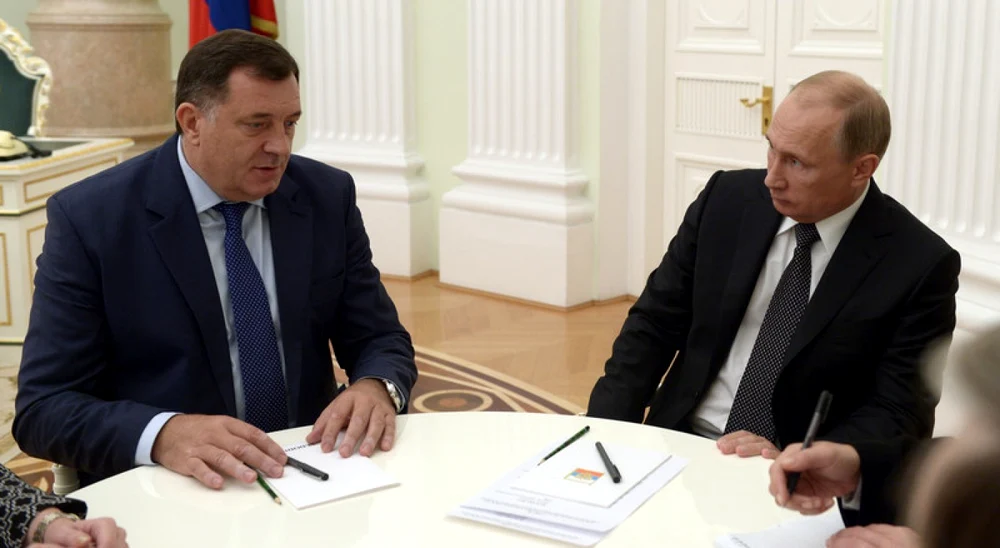
Milorad Dodik has lost his positions, but not his power. After his party’s victory in Republika Srpska, the leader of the Serbian separatists is calling for his own army and secret services, and Bosnia and Herzegovina remains blocked on the road to the EU, writes Evropeiska Pravda.
Can Bosnia and Herzegovina finally shake off the image of a country on the brink of disintegration and unlock the path to EU membership?
The elections of October 4th have offered the country a chance in this regard. The Bosniaks voted for three presidents and two vice-presidents, for the presidents of three parliaments, and for over 500 deputies.
Just the number of functions shows how complex the Bosniak political system is and how easily it can be unbalanced. This primarily applies to Milorad Dodik and his formation. Before the vote, there were hopes that the separatists from the Serbian entity, Republika Srpska, would become history, along with the idea of destroying the integrity of the state.
The renewal should have been facilitated by a package of changes to the electoral legislation, adopted earlier. Voters were biometrically identified, through fingerprint reading. Each polling station received digital scanners for the ballots and video cameras. Electronic voter registers appeared, and it became more difficult for parties to “negotiate” positions in the electoral commissions.
However, has Bosnia managed to seize this opportunity?
Very different presidents
The political structure of Bosnia and, especially, the electoral legislation are based on ethnic division. The Dayton Agreements, on which the state system is founded, recognize three constituent peoples: Bosniaks, Serbs, and Croats. Those who do not belong to these groups are classified as “others” and have significantly limited rights to elect and be elected.
Each of the three nations elects a member of the Bosnian Presidency, a kind of “collective presidency” of the country.
Four candidates competed for the seat reserved for Bosniaks. According to preliminary results, the winner is Denis Bećirović, the incumbent member of the Presidency, candidate of the coalition “United for the state of Bosnia and Herzegovina”, which brings together 14 parties. The coalition declares itself as centrist, civic and pro-Bosniak, it is pro-European and committed to democratic institutions, as opposed to ethnonationalist radicalism. From an ideological point of view, however, it is very heterogeneous, which will make Bećirović’s work more difficult.
Details, HERE


