







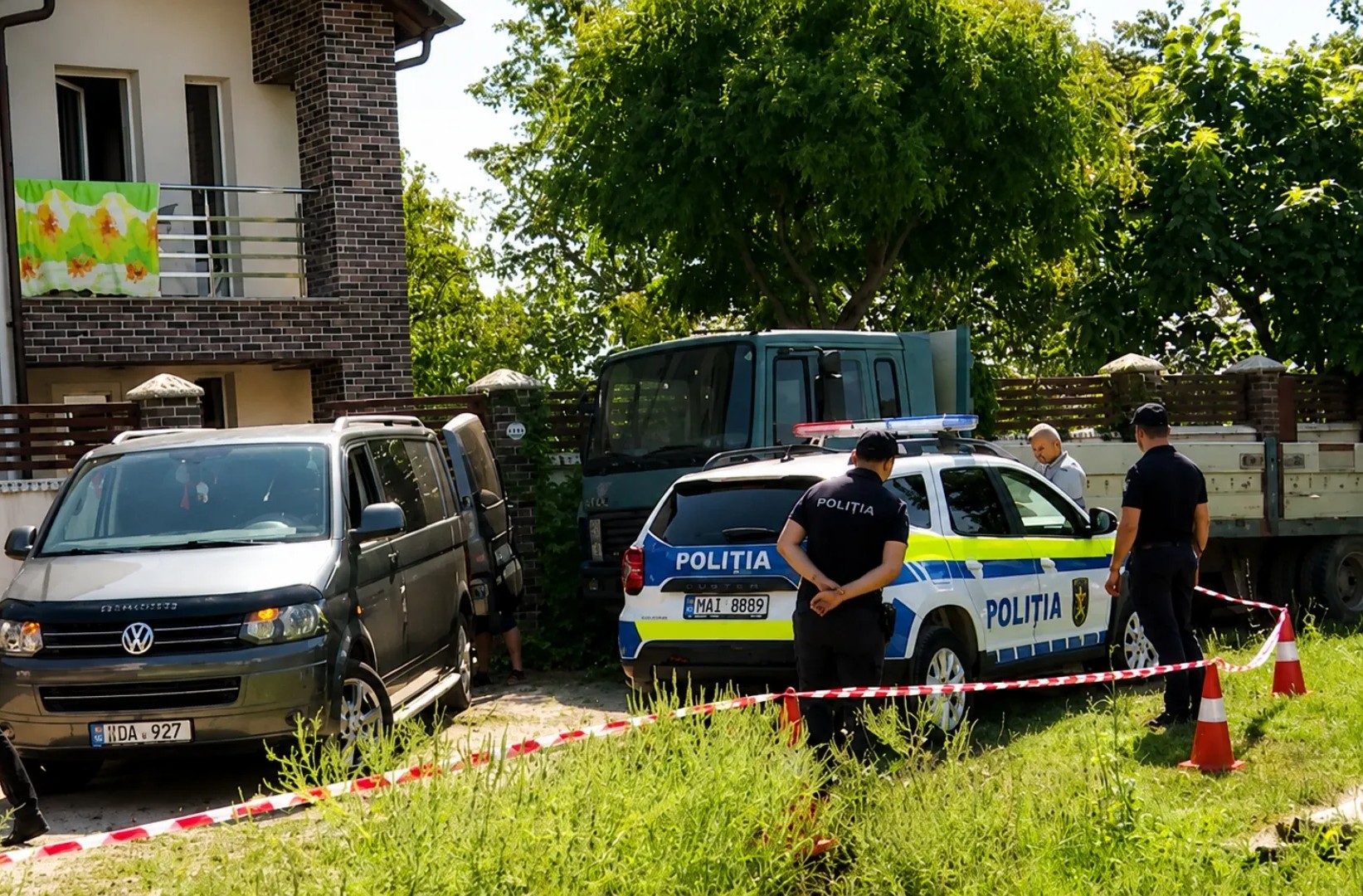
The domestic violence victim protection system in the Republic of Moldova has suffered a fatal failure. In the village of Măgdăcești, a 47-year-old man fatally shot his 42-year-old wife, then committed suicide. The woman was killed despite having two protection orders, and the aggressor wore an electronic monitoring bracelet. We explain why, according to the police and probation inspectorate, the protection system did not work and how this institutional failure could affect other victims of domestic violence.
The Chronology of the Tragedy
The first protection order, which prohibited the aggressor from Măgdăcești from approaching his wife, was issued by the Criuleni Court on July 16. However, on August 3, the man violated the order by calling the victim, and on August 24, the woman requested a new protection measure. At that time, the man had not yet been required to wear an electronic bracelet, through which his movements could be monitored. According to the law, wearing an electronic bracelet is just one of the measures provided for the protection of domestic violence victims.
The second protection order was issued by the court on August 25th. This time, the protective measures also targeted the couple’s three daughters, aged 20, 15, and 7. Moreover, the court ordered the man to wear an electronic bracelet, to monitor compliance with the imposed measures. The press also reported that the woman had filed for divorce on August 4th.
The murder took place on the morning of August 31. According to preliminary investigation information and statements from the mayor of Măgdăcești village, Liuba Cojocaru, the man used a homemade firearm, which he possessed illegally.
When the law enforcement arrived at the crime scene, on the morning of August 31st, they found that the man was no longer wearing the electronic bracelet, and the device was not found. It is presumed that the aggressor managed to get rid of the monitoring device before committing the attack.
The electronic bracelet did not work
The Minister of Internal Affairs, Daniela Misail-Nichitin, stated, in the context of the tragedy, that the electronic bracelet could have had a technical malfunction or a manufacturing defect. “The monitoring of the bracelets is carried out by the employees of the Probation Inspectorate. In case of loss of the GPS signal or if the wearer gets closer to the victim at a distance smaller than the allowed one, they are obliged to inform the police. In this case, this did not happen. Consequently, the nearest police crew did not arrive at the scene,” said the minister.
At the same time, the minister denied the information according to which the 15-year-old daughter, who found the victim, had called 112 several times. “At the 112 Service, in relation to this case, only one call was received, on August 31, at 09:16. At 09:17, the call was redirected to the Criuleni Police Inspectorate. No other calls related to this case were received,” the minister specified.
Regardless of the reason why the bracelet’s signal has disappeared, security protocols require immediate intervention. In such a situation, the person wearing the bracelet must be urgently contacted, and a police crew must be dispatched to check the location where it is located. And, most importantly, the protected person must be immediately warned about a possible danger.
The Minister of Justice, Vladislav Cojuhari, stated that the man was fitted with the electronic bracelet on August 25, at 16:50, at the Criuleni Probation Office. However, shortly after, the GPS signal disappeared from the monitoring platform, even though the SIM card continued to transmit data, but without location information. Contacted by phone by inspectors, the man told them he was in Orhei. At 20:34, he called the Electronic Monitoring Directorate and announced that he was leaving the Republic of Moldova for 4-5 days. Subsequently, the GPS signal disappeared permanently.
Between August 25-30, the man was abroad. The Border Police confirmed that he was absent from the country during this period. The man was engaged in bringing cars to the Republic of Moldova, so frequent trips abroad were part of his activity, and the protection order did not prohibit him from leaving the country. On August 28, he responded to the probation officer’s call and communicated that he was in Germany.
Upon returning to Moldova, the system did not detect him due to signal loss. On the morning of August 31, the inspector tried several times to contact the man by phone, knowing that his travel period had expired, but he did not answer.
The reaction of the authorities
The General Prosecutor’s Office has initiated a criminal case to determine all the circumstances of what happened. In parallel, the National Probation Inspectorate announced an internal investigation to determine whether the institution’s employees complied with electronic monitoring procedures and how they managed potential risk signals. A separate investigation is also being conducted by the Probation Inspectorate, the prosecutor’s office, and the Criuleni police.
The day after the tragedy, the Ombudsman, Ceslav Panico, initiated his own investigation into the killing of the 42-year-old woman from the village of Măgdăcești. Following this, the Ombudsman intends to provide a legal assessment of the actions of the authorities in the context of Moldova’s international obligations. Specifically, to verify whether the state has fulfilled its obligations regarding the protection of the fundamental right to life, guaranteed by Article 2 of the European Convention on Human Rights. In addition, the situation will be analyzed from the perspective of compliance with the standards of the Istanbul Convention, which obliges authorities to prevent acts of domestic violence and ensure the effective operation of legal mechanisms for the protection of victims.
On September 2, the director of the National Probation Inspectorate, Viorel Sochircă, resigned. This was announced by the Minister of Justice. The official believes that the recent tragedy in the village of Măgdăcești has demonstrated the inability of the electronic monitoring system to ensure the protection of domestic violence victims.
According to the minister, the incident revealed procedural gaps, lack of resources, and issues related to the use of electronic bracelets abroad. He presented statistics showing that currently, there are 354 people in the monitoring system, more than half of which (190) are domestic aggressors.
“What we need to do now is urgently correct procedures where they have failed and allocate resources where necessary. We will propose that the General Inspectorate of Police have direct access to the monitoring system in order to intervene promptly. Also, we will recommend that domestic aggressors, even if they do not have a ban on leaving the country, be put on notice at the border crossing, so that there is information sharing between institutions,” he said.
PAS Deputy Doina Gherman stated, in her turn, that resignations are a start, but they do not represent a solution. “The answer is a system where no woman dies anymore with a protection order in her hand. I will say it straightforwardly, because any other phrasing would be an insult to the memory of the woman killed in Măgdăcești. She did everything right. She filed complaints. She asked for protection. She obtained not one, but two protection orders. She trusted that the law would protect her. The law exists. The institutions that were supposed to enforce it — were not there. (…) This is not just a crime. It is a femicide that could have been prevented,” Gherman wrote, demanding accountability from “every person who was supposed to watch over and did not watch over” the victim.
The opinion of human rights defenders
Vadim Vieru, the lawyer of the “Promo-LEX” Association, which defends human rights in the Republic of Moldova, also maintains that the woman did everything that the law prescribes to ensure her protection: she filed complaints, obtained a protection order back in July, and on August 25, she managed to secure the application of an electronic bracelet to the aggressor.
“The police didn’t receive any alert. The bracelet was not found. The Ministry of Internal Affairs states that “it might not have worked”. The aggressor left the country on the 25th and returned on the 30th, no one reacted,” Vieru wrote on social networks.
He expressed his skepticism regarding the state-initiated checks, assuming that the investigations will most likely boil down to abstract formulations about “inter-institutional gaps” – without specific names and without real consequences for the guilty officials.
The main problem, in Vieru’s opinion, will be the way this institutional failure will affect other people who are victims of domestic violence and who will now be afraid to ask for help. “The message for any woman beaten at home is already clear – you filed a complaint, you got a restraining order, they put a bracelet on him and yet you died. Who will call 112 after this? The police and probation will have to convince victims to literally entrust their lives to them, and this case has shown them how much their promise is worth,” he concluded.


