
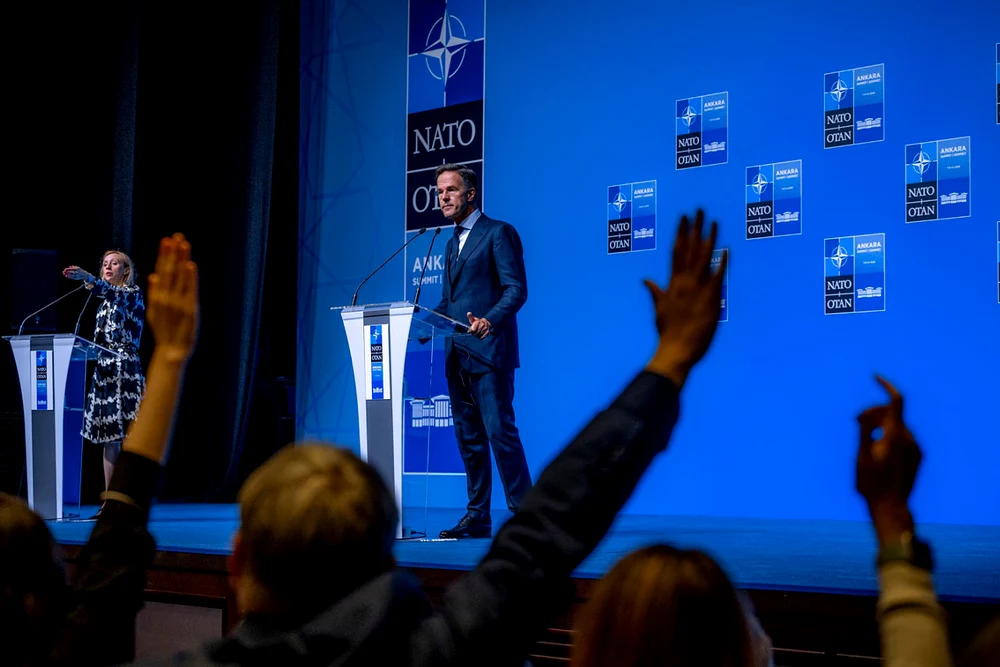
The first day of the NATO Summit in Ankara concluded with an unprecedented announcement in the history of the Alliance, the joint acquisition of 5 Triton surveillance drones, the first of its kind since 1949. The decision comes just a few weeks after a Romanian Air Force F-16 shot down a drone over Estonia, and Ukraine continues to be hit daily by waves of Russian Shahed-type drones.
In such a context, “Adevărul” discussed with reserve general Dorin Toma, former commander of the NATO Multinational Division South-East Command, and with Claudiu Degeratu, security expert and former head of the Defense Section of the Permanent Delegation of Romania at the NATO headquarters in Brussels, about what, in reality, drone defense means for the Alliance and for Romania.
The announcement was made at the Ankara Defense Industry Forum, organized on the margins of the NATO summit on July 7-8. Secretary General Mark Rutte confirmed that the Alliance will acquire 5 MQ-4C Triton drones, with participation from Norway, Finland, Germany, and Denmark. Romania is also involved in the NATO Drone Edge initiative, at a time when the drone threat has become a direct reality for Romania. On May 29, a Russian Shahed-type drone hit a block in Galați. Two people were injured, and several families were evacuated from their homes.
Through the Drone Edge Initiative, the Alliance aims to rapidly expand its ability to produce, operate, and neutralize drones on a large scale, considering drone and anti-drone capabilities essential for deterrence and defense posture. Specifically, the commitments made in Ankara include an investment of over 40 billion dollars in anti-drone capabilities over the next 5 years, along with the creation of a NATO market dedicated to anti-drone solutions, which will be added to the national markets and other existing procurement mechanisms.
The lesson that Ukraine gives every day
General Dorin Toma begins the discussion from the direct experience of the Ukrainian Army, constantly faced with waves of Russian drones. The former NATO commander explains why not every aerial threat should be dealt with expensive weaponry.
“We must learn from what the Ukrainians do every day. They are constantly facing attacks from Russian Shahed-type drones, also known as Gheran-2, and more recently Gheran-3, which are turbojet-propelled and have higher speeds. The main lesson is that such threats can be effectively combated without always using extremely expensive and sophisticated interceptors or missiles,” explained General Dorin Toma.
He observes that the European defense industry has already begun to adapt to this type of conflict, through direct collaboration with Ukrainian anti-drone system manufacturers.
“Numerous companies from the defense industry, from Poland, Germany, Great Britain, and other countries, have entered partnerships with Ukrainian firms to develop anti-drone defense systems inspired by frontline experience. Many of these technologies have already been integrated into their own armies,” emphasized General Dorin Toma.
Details, HERE