
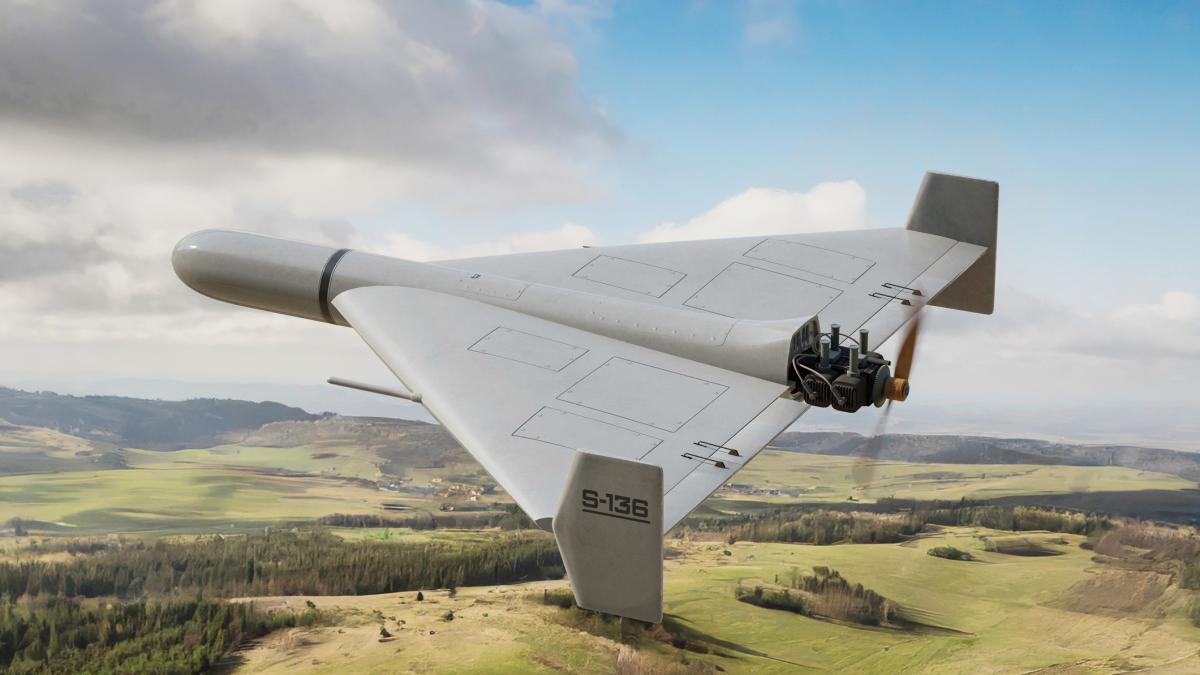
The incidents with Russian drones that recently crossed the borders of Poland and Romania have not only sparked political concern in Brussels — they have revealed a technological weakness of the West. Out of approximately 20 Russian Gerbera drones that crossed the border into Poland, at least 15 were not intercepted: they fell from the sky when their fuel ran out. Some were shot down, but the price paid was huge — AMRAAM missiles launched for each drone, costs orders of magnitude greater than the UAVs, plus the expense of getting fighter planes airborne, writes the Russian publication Meduza.io.
After watching for more than three years the devastations on the Russo-Ukrainian front, a large number of military analysts believe that drones have triggered an irreversible revolution in military art — one that questions Western doctrines. Other voices, however, warn that the dominance of drones on this theater of operations is largely the result of improvisations and weaknesses of both armies; under other conditions, other means may come to the fore. The skeptics’ conclusion: The West should not simply mimic mass production in Russia or China, but must learn to fight effectively against drones. The analysis of the Russian publication tries to unravel the “drone revolution” and show what it could mean for the war of the future.
What does the “drone revolution” mean?
Ukrainian data shows that in 2025 over 70% of battlefield losses are attributed to drones — a figure that, although harsh, remains a partial illustration of the transformation. In this war, drones not only replace certain weapon systems: they redefine tactics, operational art, and in some cases, strategy.
Ruslan Puhov, a high-profile Russian analyst, argues that drones and their sensors are not just isolated devices, but the tip of a communications system capable of transmitting real-time video streams and data to many consumers — from local operators to higher commands. This connection, between sensor and commander, undermines what has always been called the “fog of war”: when thousands of drones provide permanent eyes on a front, the traditional anticipation of commanders loses importance.
The logical consequence: arming drones to immediately strike the discovered target. The time between reconnaissance and attack is almost compressed to zero; even less advanced armies gain large-scale reconnaissance capabilities and precision ammunition. The tactical consequence — already observed in Ukraine — is the disappearance of the possibility to mass forces openly: hiding and dispersion become rules, not exceptions. Deep armored breaches, which have defined modern land conflicts, become impossible without drone/antidrone supremacy.
Puhov argues that, once integrated with artificial intelligence and satellite communications, drones will be able to strike at almost any depth. Whoever controls these means will have a huge advantage on the ground. Some ideas that seemed theoretical three years ago are — in places — reality on the Ukrainian front: the proliferation of reconnaissance drones and kamikaze ammunition has significantly reduced the possibility of conventional concentrations.
Read more HERE