



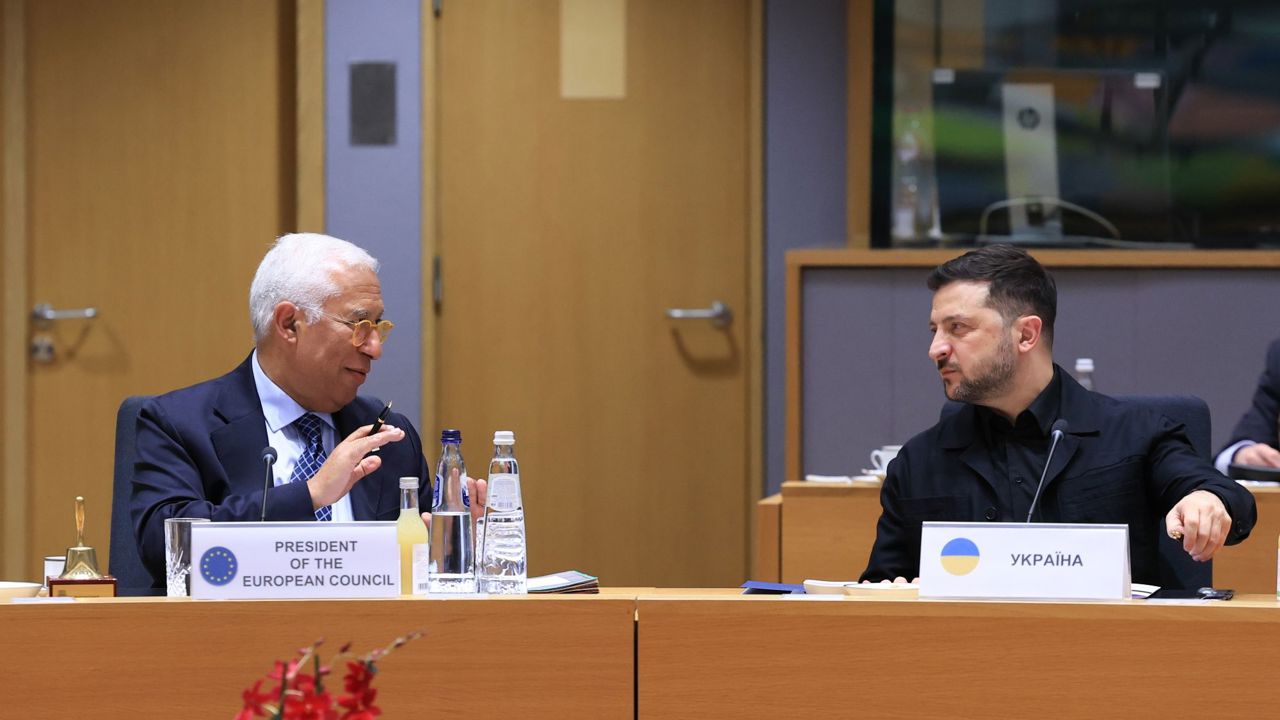
The European Council Summit on December 18-19, held in Brussels, is considered crucial for the future of financial support granted to Ukraine, in the context of the United States’ reduced involvement and increasing pressures for a peace agreement. The main stake is the use of Russian assets frozen in Europe to finance Kiev in the coming years, an initiative strongly promoted by German Chancellor Friedrich Merz.
In an interview for Moldova 1, DW journalist Alina Kühnel explained that this summit comes after weeks of intense negotiations and concentrated diplomatic efforts, especially in relation to Belgium, the state where most of the blocked Russian funds are located.
According to the journalist, the involvement of Russian assets in supporting Ukraine has become a personal project of the German Chancellor, who has insisted in recent weeks on the release of the funds.
“We know that, out of the 210 billion euros held by the Central Bank of Russia in Europe, 185 billion are in Belgium, and at least 90 billion would be needed in the next two years for Ukraine,” Kühnel specified.
She noted that Merz had direct and repeated discussions with the Belgian Prime Minister, who continues to express reservations.
After months of hesitation, the European Commission came up with a new mechanism, designed to overcome political and legal blockages. Specifically, the EU will not directly confiscate the assets, but will use them as a guarantee for a massive loan to Ukraine.
“In practice, this money is granted as a loan to Russia, and when the payments for war reparations will be made, after a durable peace is reached and Ukraine is rebuilt, the rest of the money will return to the Central Bank of Russia,” the DW journalist explained.
The plan, although innovative, faces opposition from several member states.
“Belgium is particularly fearful, especially from a legal point of view, because if it were to transfer the money from Belgian banks to Ukraine, it might later have to answer alone for this decision,” Kühnel specified.
In addition, Italy, Hungary, the Czech Republic, and probably Slovakia, have expressed reservations, making the negotiations difficult and lengthy.
“The European Union has no alternative”
Asked how realistic the use of frozen assets is and whether the EU is prepared to go all the way, Alina Kühnel responded decisively.
“The European Union should be, because it has no alternative,” the journalist said, specifying that the second solution – a joint loan on the financial markets, as the Commission did on behalf of all member states during the COVID-19 pandemic – would be harder to implement.
“The joint indebtedness of European states would require a unanimous vote, and we know very clearly that Hungary opposes this option,” Kühnel pointed out, on the public television station.
A signal of unity, essential also for Washington
Beyond the concrete decision on financing, the DW journalist says that the political message of the summit is just as important.
“The clearest would be a signal of unity. It would be very important for Europeans to speak with one voice after the summit and to also send a signal of unity to Washington,” Kühnel said, referring to recent criticisms by President Donald Trump of Europe.
In parallel with European efforts, the United States has intensified its own diplomatic initiatives, and Miami has become, almost unexpectedly, a new center of negotiations.
According to her, American envoy Steve Witkoff and Jared Kushner, Donald Trump’s son-in-law, are set to inform Putin’s envoy, Kiril Dmitriev, about recent discussions with the Ukrainian side, after which a Ukrainian delegation is expected to go to Miami.
We specify that in Brussels, on December 18 and 19, the last meeting of the European Council is taking place, where the leaders of the 27 states are trying to find a solution regarding financial support for Ukraine and to discuss topics such as expansion, the geoeconomic situation, and the strengthening of European defense and security.