





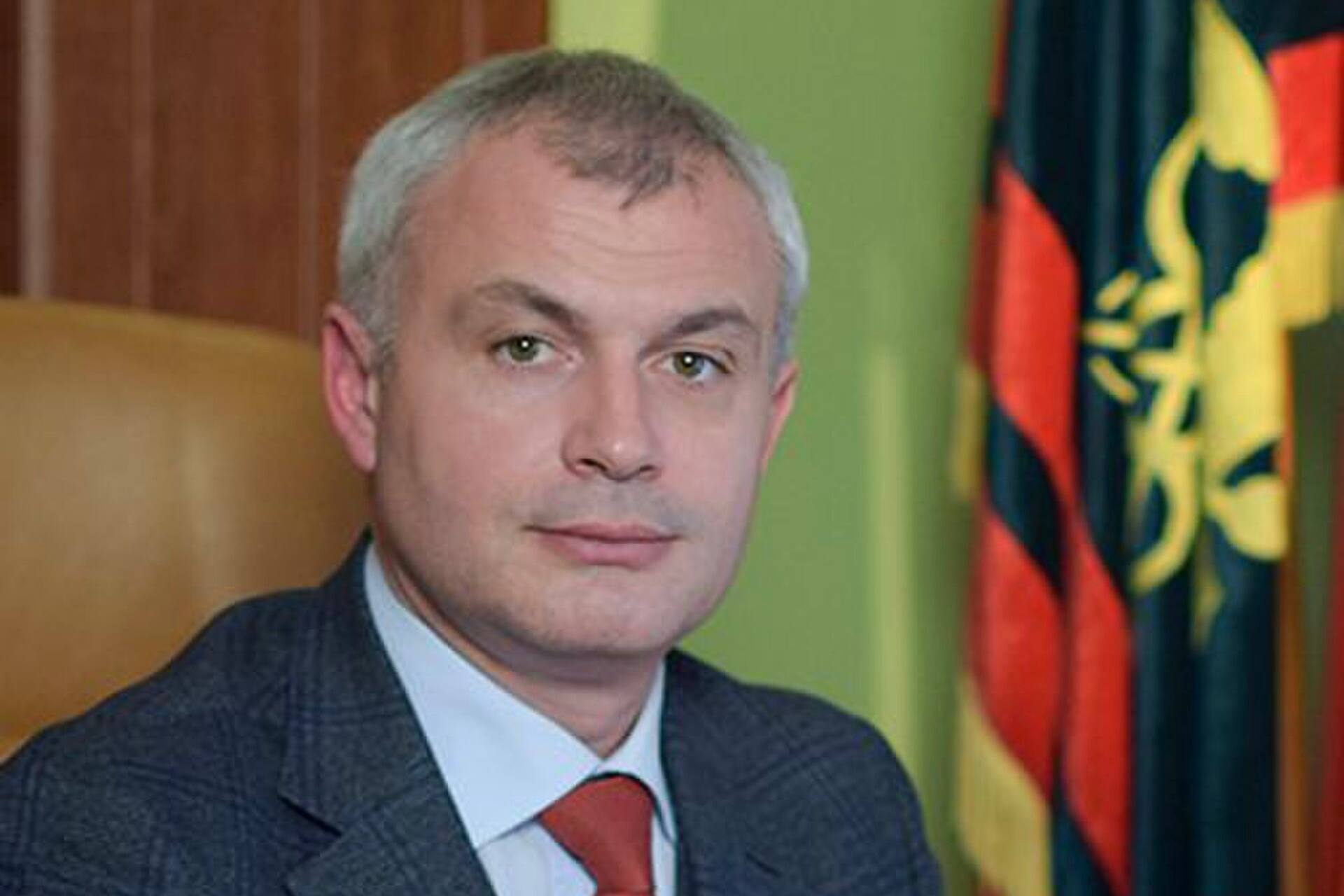
The public presence of the so-called Deputy Prime Minister of the Transnistrian region, Vitali Neagu, in the Tiraspol press significantly increased in 2026, and the topics in which he appears have diversified – from economic and administrative issues to political subjects and relations with Chisinau, Russia, and the OSCE.
IPN analyzed over 24 thousand messages published on three Telegram channels close to the Tiraspol regime and tracked how the public visibility of Vitali Neagu changed after his appointment as Deputy Prime Minister.
Interest in Neagu has grown against the backdrop of discussions about a possible future leadership of the region. In September, the Russian press picked up information published by a fake Telegram channel, created in Neagu’s name, according to which he would have plans to run for the position of “president” of the region.
From January 1 to September 29, 2026, IPN analyzed 24,091 messages published on the Telegram channels “Первый Приднестровский”, “ТСВ” and “Новости Приднестровья”. The analysis shows that, over the course of eight months, not only has the number of materials about Neagu increased, but also the range of topics, events, and public roles in which he appears.
In February – the first full month after his appointment as deputy prime minister of the so-called government – Neagu’s name appeared in 32 publications. By September, this number had reached 165.
At the same time, 87% of the materials from September mentioning Neagu did not also mention Vadim Krasnoselski. This indicates an increasingly autonomous presence of Neagu in the informational agenda.
Methodology
The analysis was based on the complete exports in JSON format of the three state channels and affiliates of the “Sheriff” holding: “Первый Приднестровский”, “ТСВ Приднестровье” and “Новости Приднестровья | ПМР”. The data covers the period from January 1 to September 29, 2026 and includes 24,091 messages.
The aim of the research was to measure the media presence of Neagu and to compare its evolution with that of Vadim Krasnoselski, the so-called foreign minister Vitali Ignatiev, and the chairwoman of the Supreme Soviet, Tatiana Zalevskaia.
From 32 to 165 publications
On January 27, 2026, the administration in Tiraspol announced that, starting from January 28, Vitali Neagu will become the deputy prime minister of the so-called government. Previously, he led the so-called interior ministry of the region.
In February, Neagu’s name appeared in 32 publications of the three analyzed channels. In March – in 127. Subsequently, the number decreased, but it never returned to the level of February. In September, a new record was reached – 165 publications.

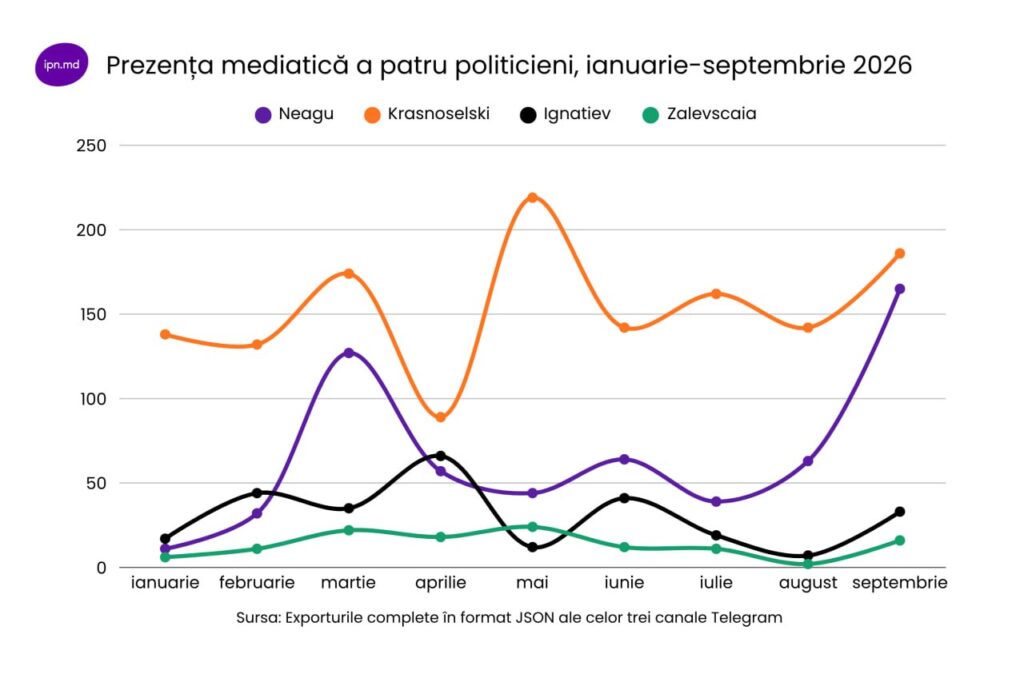
From February to September, the number of publications mentioning Neagu has increased more than five times, and their share in the total published materials has grown from 1.15% to 5.82%.
Not just more publications, but also more roles
At the beginning of the year, Neagu mainly appeared in materials related to his responsibilities as Deputy Prime Minister: investments, construction, medicine, municipal services, and digitization.
In February, the “Tehnobek” forum becomes one of the projects associated with Neagu, being presented as the initiator. In the spring and early summer, he regularly appears at meetings dedicated to the Capital Investment Fund and major infrastructure projects.
In the summer, the range of events he participates in expands. On July 21, Neagu takes part alongside Krasnoselski in a religious service organized at the Military Institute, before the installation of crosses on the church under construction. In September, he is among the first visitors of the new halls of the Transnistrian Museum, together with Krasnoselski, Igor Smirnov, Tatiana Zalevskaia, and the so-called Prime Minister Alexandr Rozenberg.
Thus, to the economic and administrative agendas are gradually added education, culture, religious and commemorative events, and later also political subjects.
What sets Neagu apart from Ignatiev and Zalevskaia
During the period under review, Krasnoselski was mentioned in 1,384 publications, Neagu – in 602, Ignatiev – in 274, and Zalevskaia – in 122.
Krasnoselski remains the central figure, however, the evolution of the media presence of the others varies.
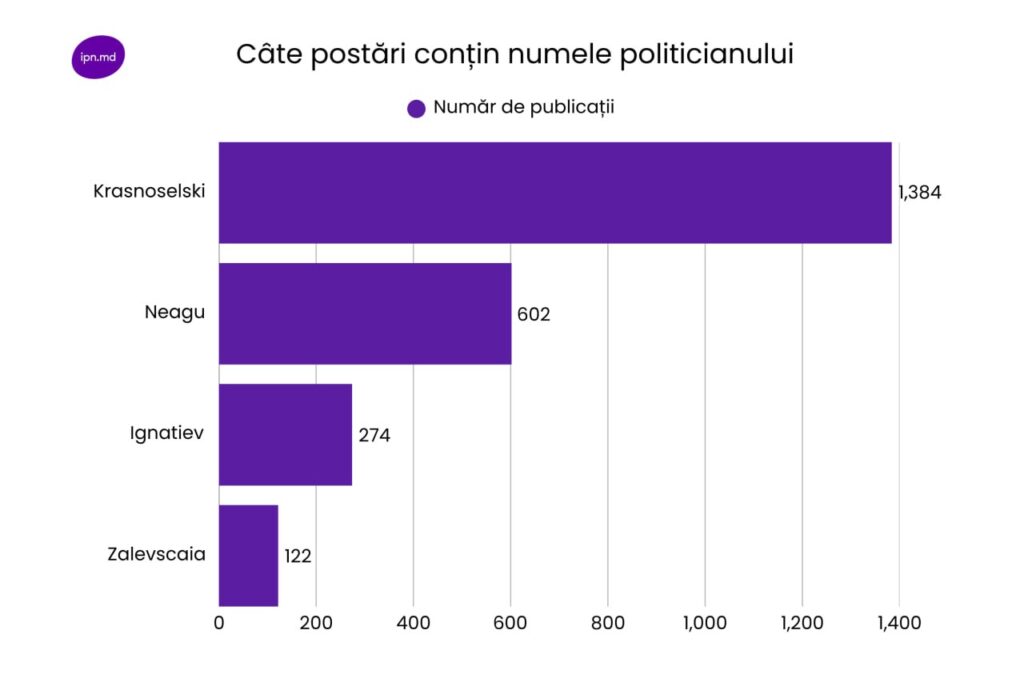
In the case of Ignatiev, this is closely linked to foreign policy and negotiations and varies from one period to another. In the case of Tatiana Zalevskaia, public presence remains primarily institutional and ceremonial.
In Neagu’s case, after the increase in March, the number of publications decreased, but it did not return to the initial level, and in September it reached a new peak.
At the same time, the scope of his statements has expanded. In September, Neagu commented not only on the activity of the so-called government, but also on relations with Chisinau, reintegration, peacekeeping operations, OSCE, Russia and the elections in Russia – topics that far exceed his area of responsibility.
The closer the elections get, the more autonomous his agenda becomes
September was the most intense month for Neagu: 165 publications. Only 22 of these mentioned Krasnoselski at the same time.
In the other 143 materials – 87% – Krasnoselski was not mentioned.
Specifically in September, Neagu’s own agenda becomes particularly political. The state press and media institutions close to the official agenda serially publish his statements made following the interviews given for RIA Novosti: about Chisinau and reintegration, the peacekeeping operation, negotiations, OSCE and relations with Russia.
A single interview thus manages to generate multiple separate news, in which Neagu becomes the main source of political messages.
Therefore, it is not enough to simply say that he appears more often alongside Krasnoselski. By autumn, a significant part of Neagu’s media presence is already shaping up independently from the region’s leader.
Elections for the State Duma: a new public role
The September campaign for the elections in the State Duma of Russia highlights the difference between the public roles of Krasnoselski and Neagu.
Krasnoselski first appeared primarily as an official communicating about the organization of the vote: he announced the opening of polling stations and commented on the process.
Neagu, on the other hand, participated in the vote and offered a separate comment on the importance of the Russian elections for the residents of the Transnistrian region.
For his media evolution, it is relevant that he also appeared in this subject: the organization of elections in Russia is not within his area of responsibility, however, Neagu received a platform to express his own political position.
Does this mean that Neagu is “ready for presidency”?
The data on media presence does not allow such a conclusion. They do not show any potential internal agreements, the reasons of the editorial offices, or the decisions regarding future candidates. Also, the increase in the number of public appearances and mentions in the press does not indicate either an increase or, generally, the existence of a political rating.
In September, the hypothesis that Neagu could be a possible successor entered public debate, including in the Russian press. However, there is no official confirmation in this regard.
In September, a Telegram channel was created in the name of Neagu, which posted a message about his alleged decision to run for office. The so-called government of the Transnistrian region announced that this channel was created without Neagu’s knowledge and does not reflect his political plans.
Therefore, the analysis allows only the affirmation of what can be measured: in 2026, Neagu’s media presence significantly increased, given that he was previously almost absent from the public space. In 2025, his name appeared in the same sources only once every two to four months.
At the beginning of this year, Neagu was mainly introduced as the new deputy prime minister with an economic agenda. In spring and summer, he became a participant in a wider range of public events. By autumn, he had become an independent voice on political issues that far exceed the fields of construction, medicine, or municipal services.
This measurable context forms the basis of the discussions that have arisen about a possible future political role for Neagu.


