






Tamara Eidelman, a Russian history teacher who settled in Portugal in 2022, published a lesson about the history of the Republic of Moldova on her YouTube channel with 18 million followers. In over two hours of narration, from Dacia and the Roman Empire to the war on the Nistru, the blog author made numerous mentions of the “Romanization” of the local population.

(Note: This is a HTML code snippet containing a YouTube video link. It doesn’t contain any Romanian text to translate.)
Eidelman attempted to explain the difference between the Romanian language and the so-called “Moldovan”, following the annexation of the current territory of Moldova to the Russian Empire in 1812 and the return of Bessarabia to Romania in 1918. Coincidentally or not, but contrary to her statements about “Romanization”, in her accounts about the spoken language she presented exactly the opposite – how Russian propaganda artificially created the Moldovan language through the controversial Leonid Madan, who developed the “Gramatika Moldoveniaskî“, published in Tiraspol in 1929.
Admittedly, Eidelman forgets to mention that the author of this book was later arrested by the Stalinist regime and sentenced to capital punishment, and his research was subsequently withdrawn.

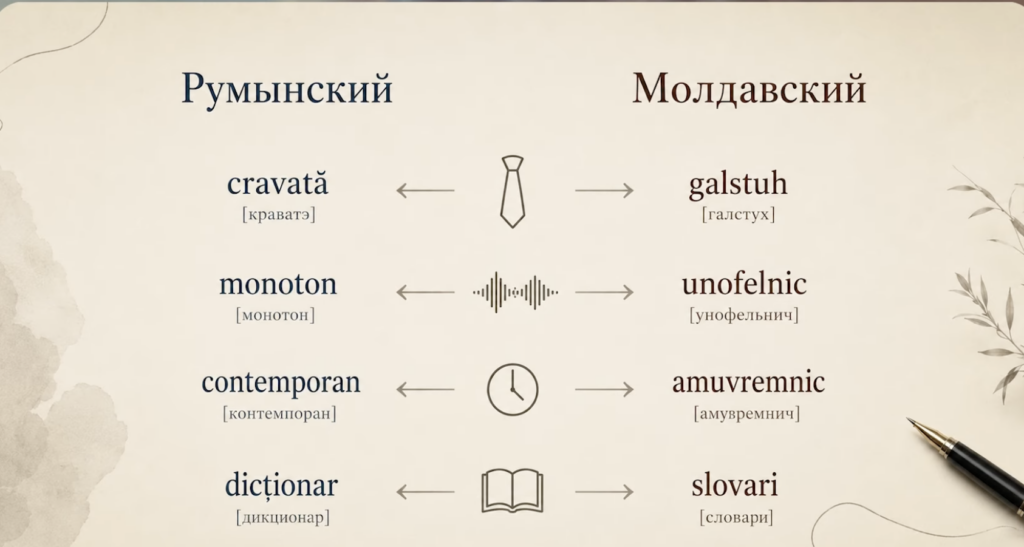
Eidelman further reported that minorities were overlooked during the period of Romanian governance and, in his opinion, the authorities imposed the use of Latin script, without considering that the locals did not possess it. According to his lesson, Romanian language courses would have been boycotted by the locals.
The statements about Romanization seem to be similar to those from the USSR era and those currently promoted by the Kremlin.
The Chisinau pogrom was associated by Eidelman with the activity of nationalist intellectuals.
The teacher also uttered the famous Soviet saying “to be a minister, you must be from beyond the Dniester,” used during the USSR period, when Moscow often promoted people born on the left bank of the river to high-level positions. In her opinion, a good part of the representatives of the elite of the time came from the territory of the current Transnistrian region.
Reporting on the 1992 war, Eidelman recounted how Igor Smirnov took power on the left bank of the Dniester, but avoided making too direct references to Russia’s involvement in triggering the conflict, stating that the Russian president at the time, Boris Yeltsin, would have actually desired the cessation of military actions.
The teacher subtly praised the influence of General Lebedi on ending the war, noting that he would have used the strategy of offense to end the military conflict by demonstrating power. More precisely, in her opinion, this is how the military would have pressured Moldova to give up defense.
Eidelman believes that peace would have been signed, because our country’s forces understood they were losing. Why Yeltsin had to send Lebedi to Moldova, however, and how the 14th Army of Russia ended up here, the professor did not explain. She spoke more about how Smirnov seized the moment to consolidate around him the minorities who disagreed with the nationalist political voices in Chisinau.
If Tamara Eidelman’s use of Moscow’s narratives in her history lesson is a result and influence of Soviet studies, the lack of other truthful information about Moldova’s history, or if there are other reasons for promoting them, only the author can answer.
It is certain that, among scientifically proven facts, his lesson was filled with more falsehoods and disinformation that were being instilled in Moldovans since the Soviet era.
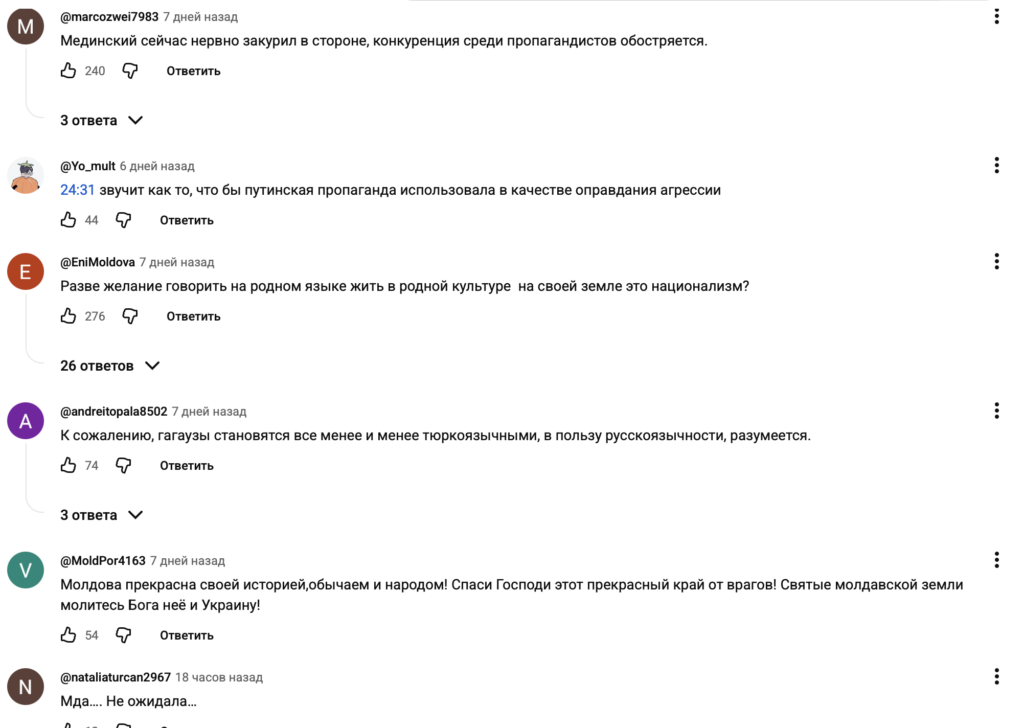
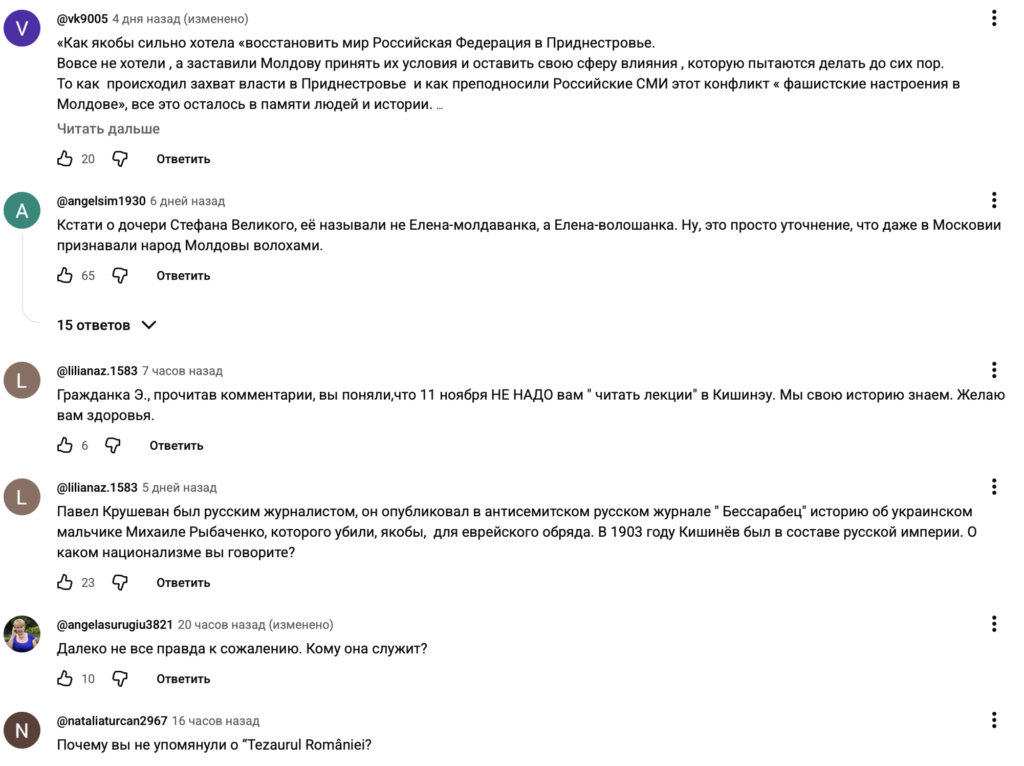
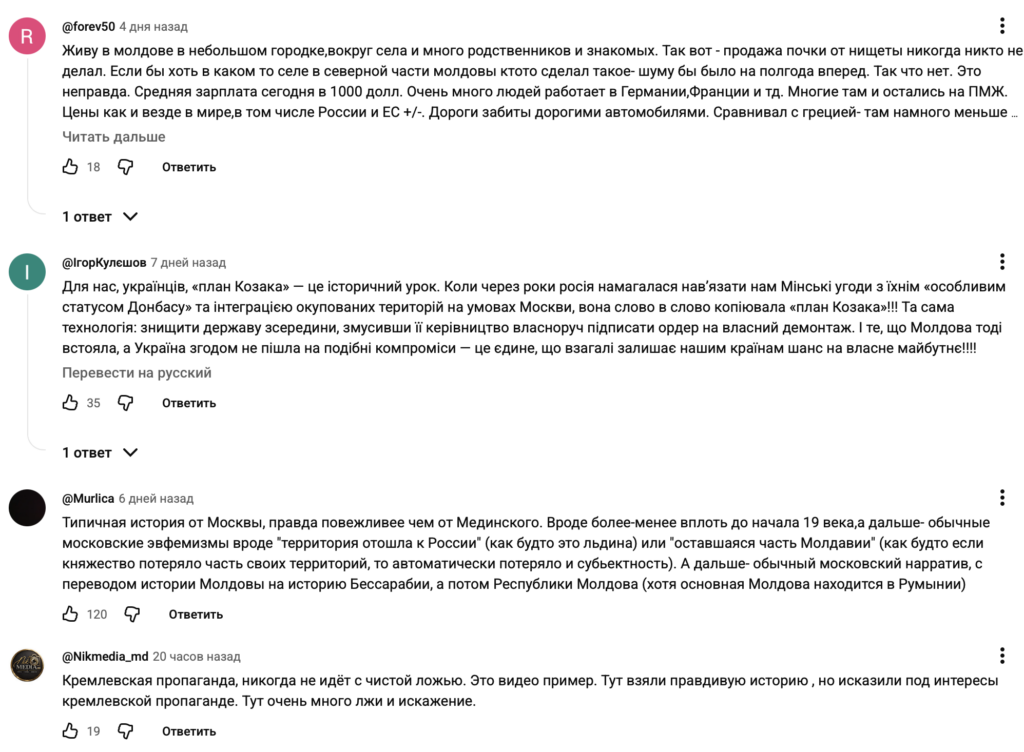
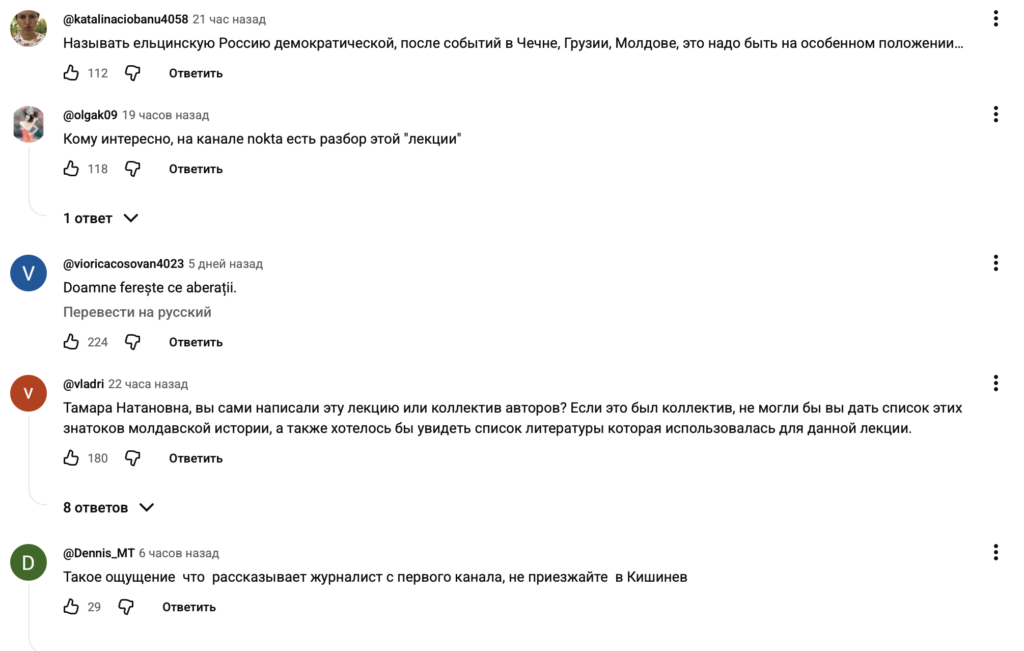
The reaction of the netizens was not long in coming, and the audience in Moldova, even the Russian-speaking one, reproached the teacher for promoting the ideas of Kremlin propaganda.

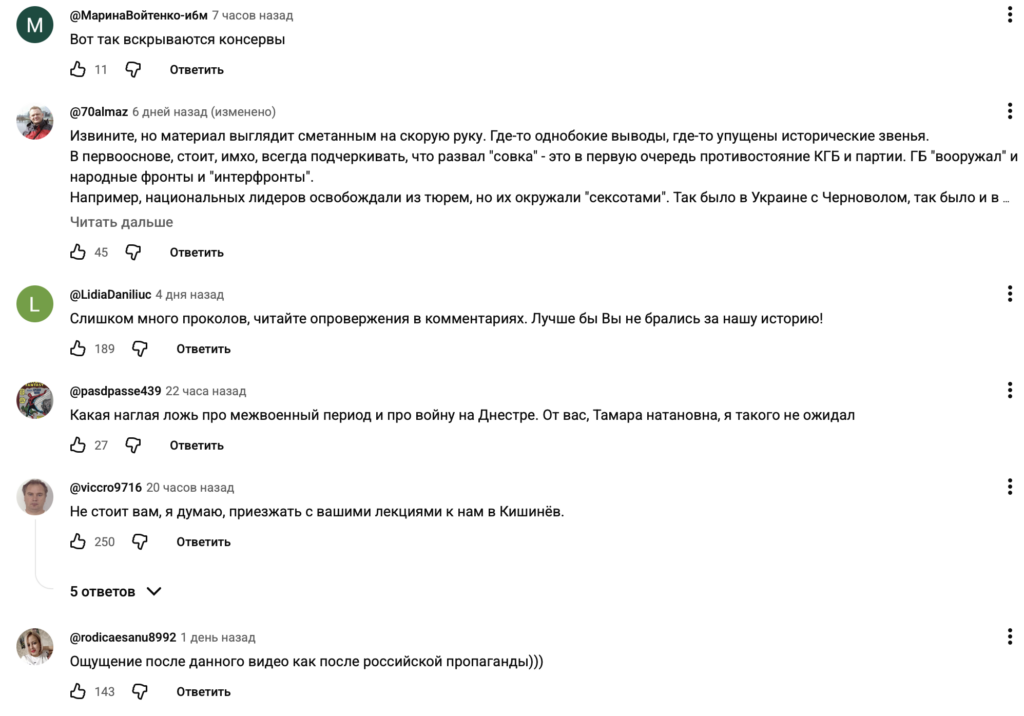




Tamara Eidelman is set to come to the Republic of Moldova to give history lessons in November. It is not yet clear whether, after the scandal with her lecture on YouTube, this visit will not be cancelled.


