
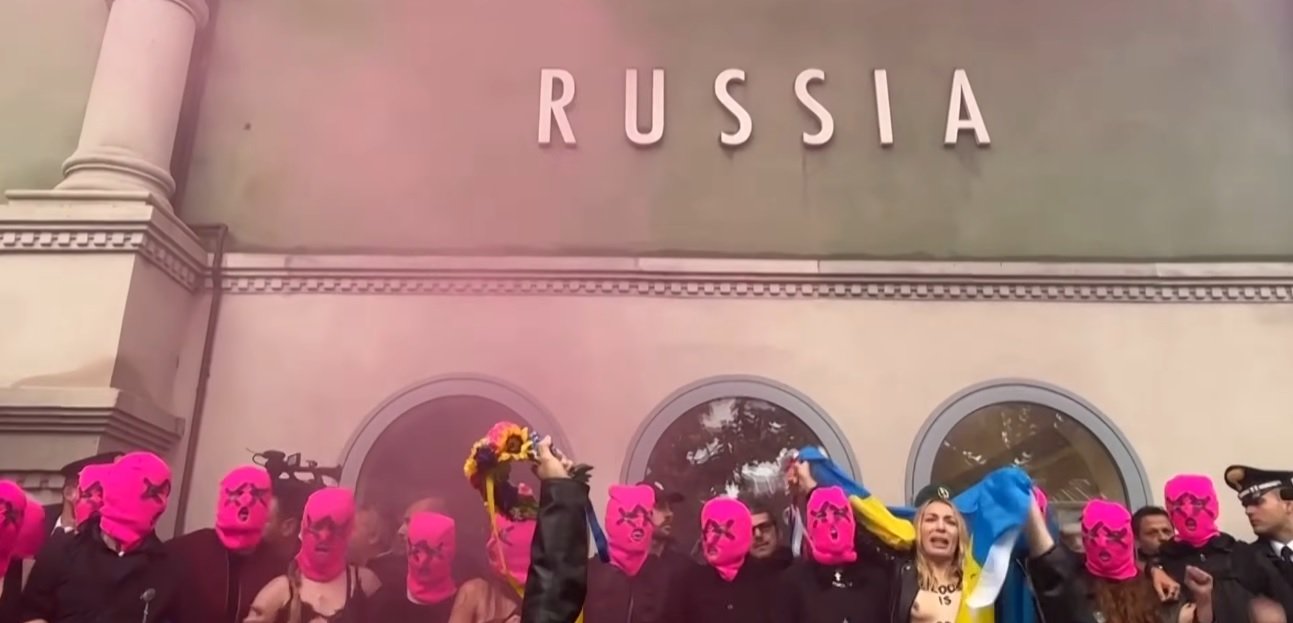
The organizers of the Venice Art Biennale were forced to close the Russian pavilion, following a protest organized by the Pussy Riot and Femen groups. Dozens of activists in pink balaclavas set off smoke bombs and chanted “Russia kills, Biennale exhibits” and “Russian art, Ukrainian blood”, expressing their dissatisfaction with Russia’s re-invitation to one of the most important cultural events in the world, for the first time since the invasion of Ukraine.
The Russian Pavilion at the Venice Art Biennale was temporarily closed following a protest organized by the Pussy Riot and Femen groups. The Venice Biennale, held every two years, is considered one of the most prestigious international contemporary art festivals. The event brings together dozens of countries that present their artists in national pavilions and is often described as the “Olympics of Art”. For many states, participation also has a strong diplomatic and external image dimension.
Russia returned to the Biennale this year for the first time since the invasion of Ukraine, which began in 2022. The return sparked strong reactions from both activists and some European officials and participating artists. The protest took place in front of the Russian pavilion, where about 40 activists wearing pink balaclavas lit smoke bombs in pink, blue, and yellow colors and played punk music. The protesters chanted slogans such as “Russia kills, biennale exhibits”, “Blood is Russia’s art”, and “Russian art, Ukrainian blood”. A statue near the pavilion was covered with a Ukrainian flag. At one point, the activists tried to enter the pavilion, but were prevented by the police.
Nadya Tolokonnikova, one of the founders of Pussy Riot, stated that she was shocked “to see parties and receptions organized in the Russian pavilion, while the war in Ukraine continues.” She accused Russia of using culture and art as tools of propaganda and political influence in Europe. However, the controversy goes beyond the case of Russia. At the current edition of the Biennale, the entire international commission that was supposed to award the Golden Lion prizes resigned, “following disputes related to the participation of countries whose leaders are targeted by international arrest warrants,” referring both to Russia and Israel.
Details, HERE