
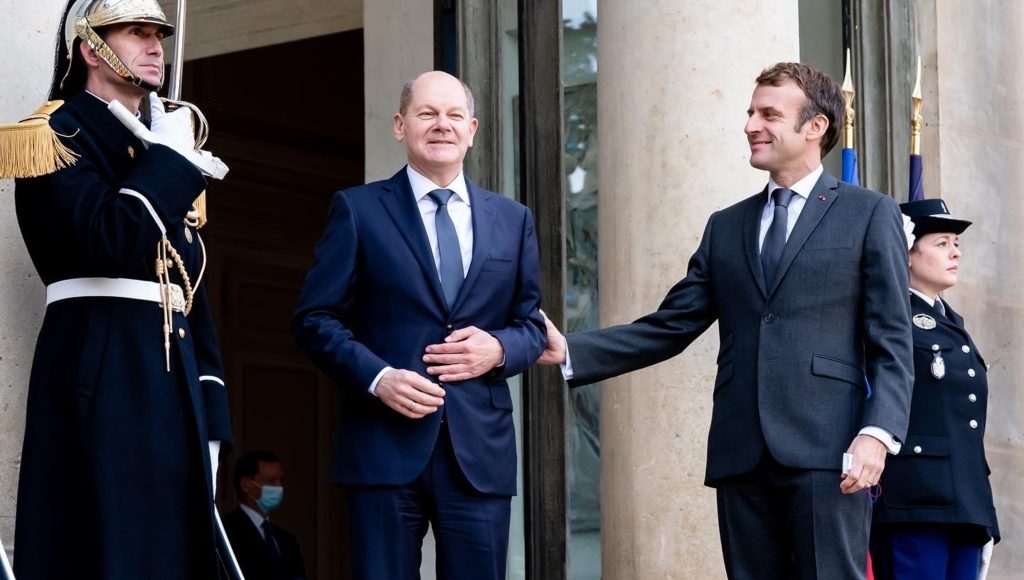
Europe is at a crucial moment in its recent history. A moment when, against the backdrop of a stagnant economy and war in its eastern part, the continent seems to lack leaders with vision and courage. As Donald Trump prepares to return to the White House, Europe urgently needs strong leadership. And right now, France and Germany — the European Union’s largest economies — do not seem capable of shouldering that responsibility, writes The New York Times.
The internal squabbles in European politics have visibly weakened the authority of German and French leaders. In Germany, Olaf Scholz, the chancellor who was supposed to revive the economy, has been forced to break up his coalition government, and in France, Emmanuel Macron is struggling to hold on to power after a crushing defeat in early elections earlier this year. Both leaders are grappling with the same forces that helped propel Trump to power in the United States: discontent with soaring inflation, frustration over immigration, and eroding public trust in political elites.
Populism is gaining ground
In both countries, traditional parties are in steady decline, and the populist and nationalist wave is growing stronger. At the European level, the message of nationalism is spreading, and in Germany, a far-right party and a new populist group have gained ground. This summer’s elections confirmed a worrying trend: more and more Germans are willing to question old political agreements and consensuses.
In France, too, Macron faces growing opposition, with domestic politics divided between the radical right and the radical left, both highly critical of his government. After calling early elections to end the deadlock in parliament, Macron has only succeeded in creating political instability and a fragile coalition, unable to adequately respond to the economic and security demands of the moment.
The power vacuum and the risks for Europe
This political instability has led to a power vacuum at the European level, and this vacuum risks being exploited by other powers, such as Russia. Europe is also in a vulnerable position in the face of a possible reconstruction of a more isolated economic world, in which the regulations and taxes imposed by Trump could have a significant impact on European industry. In this context, it will be difficult for European leaders to find common solutions to protect the internal market and to face global economic challenges, the NYT believes.
Moreover, Europe is at a crossroads in terms of military policy. At a time when threats from the east are growing and in the face of a possible American withdrawal from NATO, it is essential that the European Union find a balance between internal security and independence from external influences. But with weakened leaders and an increasingly fractured domestic politics, Europe risks missing this opportunity.
A major shift could come from other European leaders, who could try to take the reins of an independent Europe capable of responding to global crises. Keir Starmer, the new British prime minister, has already been plagued by domestic scandals, and Italy, under Giorgia Meloni, is in a delicate position, caught between supporting Ukraine and a possible rapprochement with Trump.
But the real question is whether France and Germany can overcome their own political crises. In theory, Europe’s two largest economies would be best placed to provide the direction the continent needs. But the reality is different: both countries are in a state of profound political uncertainty.
Read more AICI