

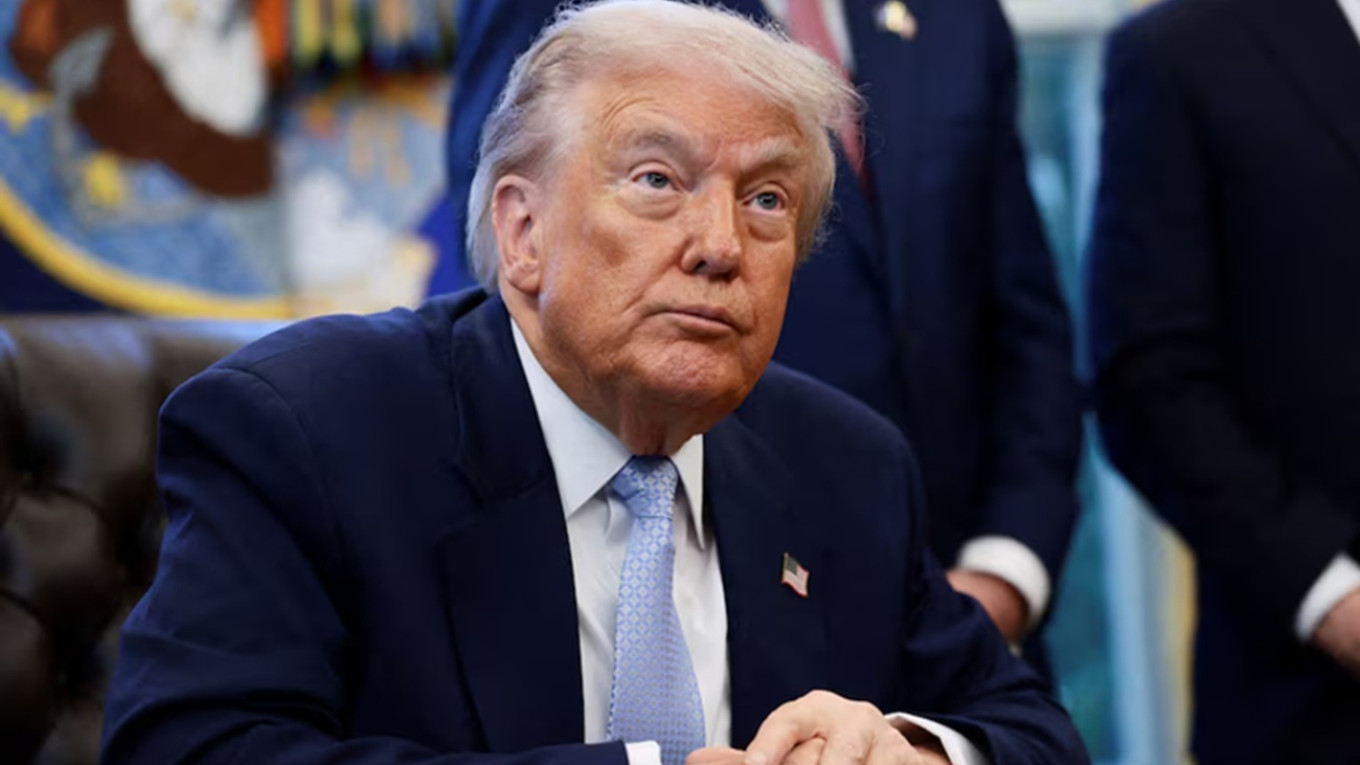
Next week, American President Donald Trump will join his NATO counterparts for a summit in Ankara, after harshly criticizing their lack of support in his war against Iran. However, the allies hope to avoid another outburst of anger in Turkey and are considering several strategies to appease the American leader.
SHOW ME THE MONEY
A year ago, under the pressure of Donald Trump, the allies agreed to allocate at least 5% of the gross domestic product (GDP) for security expenses. This time, European NATO member countries, as well as Canada, will try to convince him that they are on the right path.
Even though they have until 2035 to achieve this goal, the American president is known to be impatient and will demand proof. NATO Secretary General, Mark Rutte, who cultivates his relationship with the White House resident, provided an overview of this argument during a meeting in the Oval Office last week. Presenting a chart labeled in golden letters “THE TRUMP TRILLION” (Trump’s Trillion), he detailed the additional expenses incurred by Europe since Donald Trump came to power in 2017.
However, there are a few discordant notes that could irritate Donald Trump: three European countries, including the Czech Republic and Slovenia, are expected to fall below the 2% threshold again this year.
IRAN
Even if Donald Trump has obtained a preliminary peace agreement with Iran, the situation remains very unstable, and any escalation of tensions risks overshadowing Ankara.
Furthermore, he remains dissatisfied with Europe’s reaction during the war, when several countries restricted American forces’ access to their bases.
In an attempt to demonstrate their goodwill, France and Great Britain have developed plans for a possible mission in the Strait of Hormuz, and some countries have prepositioned ships, such as mine sweepers.
THE ART OF NEGOTIATION
Highlighting global defense spending figures could help soothe Donald Trump. But NATO also wants to show him that this money translates into enhanced capabilities, writes news.ro.
According to some diplomats and officials of the Alliance, member countries were asked to postpone the announcement of major contracts until the summit, in order to achieve a more spectacular effect in Ankara.
Some officials say that contracts worth several billion dollars are expected to be signed with American and European companies as part of an industrial forum organized on the sidelines of the summit.
Mark Rutte truly wishes to invite the American president to this event, who is passionate about signing spectacular agreements.
EUROPEANIZATION OF NATO
The United States under Donald Trump insists on the necessity for Europe to take the leading role in its own defense, and Washington has already begun to reduce its commitment within NATO.
The leaders will therefore strive to show how they are mobilizing to make NATO more “European”, for example, by increasing their “responsibilities, while at the same time trying to keep the United States as involved as possible,” explains Maria Martisiute, from the European Policy Center.
A VERY ATTENTIVE HOST
In recent weeks, Donald Trump has clashed with a series of European leaders, among them, recently, the head of the Italian government, Giorgia Meloni. But, fortunately for NATO, one of the few leaders with whom he seems to still have good relations is the Turkish president, Recep Tayyip Erdogan.
“If it hadn’t been organized in Turkey by President Erdogan, I don’t think I would have gone there,” Donald Trump himself declared last week.
The setting of the summit should suit the American president: it will take place in Erdogan’s immense presidential palace, entirely decorated with marble and gold.
SHORT SUMMIT
Ultimately, just like in the case of last year’s summit in The Hague, NATO has chosen to keep the event brief.
Donald Trump will arrive for an official dinner on July 7, before the NATO leaders hold a single short formal session the next day.
“For the summit to be successful, I would say that all we need is for Trump not to oppose NATO, not to criticize it, and not to undermine the role of the Alliance,” summarizes Peter Bator, former ambassador of Slovakia to NATO.