





A false narrative about an alternative version that would have been the basis for the pollution of the Nistru River is massively spread on social networks. The authors of this version claim that a Ukrainian truck carrying oil and fuel would have overturned on the bridge at Otaci, which led to the pollution of the river.
This information contradicts the official versions of the Ministry of Environment, as well as the data of the General Inspectorate of Police (IGP). Officials told deschide.md that there was no road accident involving a tanker in the aforementioned area.
After the Russian army bombed the Ukrainian hydroelectric power station at Novodnistrovsk in the Chernivtsi region, on the Nistru River, in the Naslavcea area, oil stains were observed. As a result, the responsible institutions initiated analyses and interventions to limit the spread of the pollutant, installing capture systems for substances in certain sectors of the river.
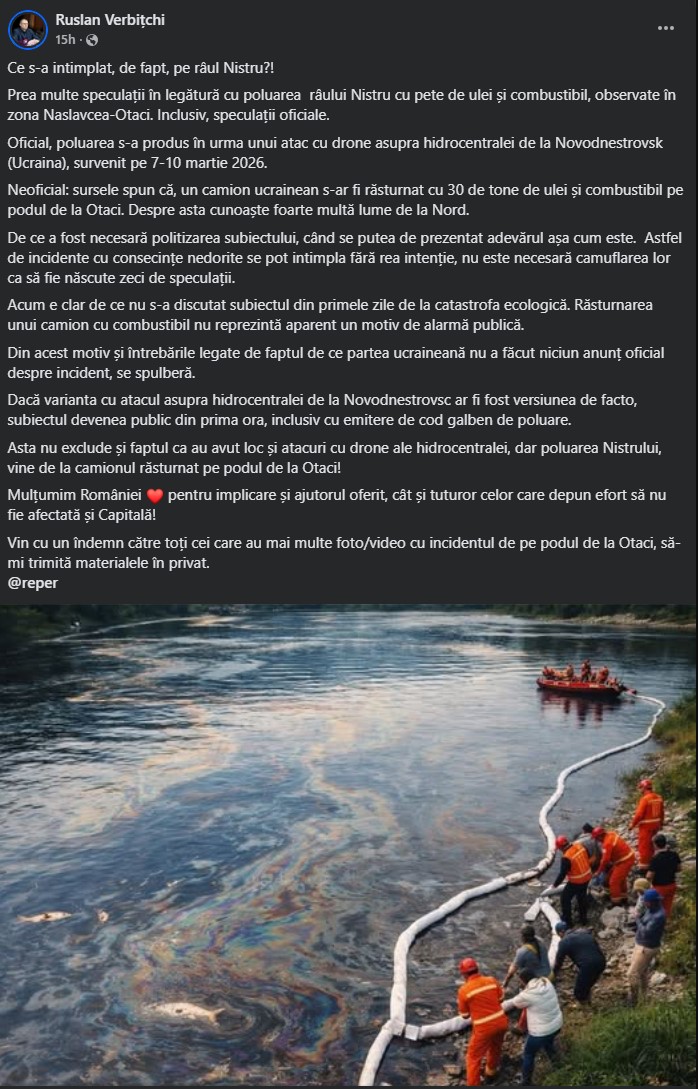
On the evening of Monday, March 16, Ruslan Verbițchi – former city councilor from the capital and ex-candidate for the position of deputy in the elections of September 28, 2025 from the Union of Centrists from Moldova (UCM), announced that, from the information he holds, the pollution occurred after “a Ukrainian truck would have overturned with 30 tons of oil and fuel on the bridge at Otaci“. In support of his version, Verbițchi states that “many people from the North know about this“.
“If the version with the attack on the hydroelectric power station at Novodnistrovsk would have been the de facto version, the subject would have become public from the first hour, including with the issuance of a yellow pollution code“, he wrote.

Contacted by reporters deschide.md, the head of the Communication and Protocol Section within the National Police, Diana Fetco, stated that, during the past week, no road accidents were recorded at Otaci involving trucks carrying fuel or oil.
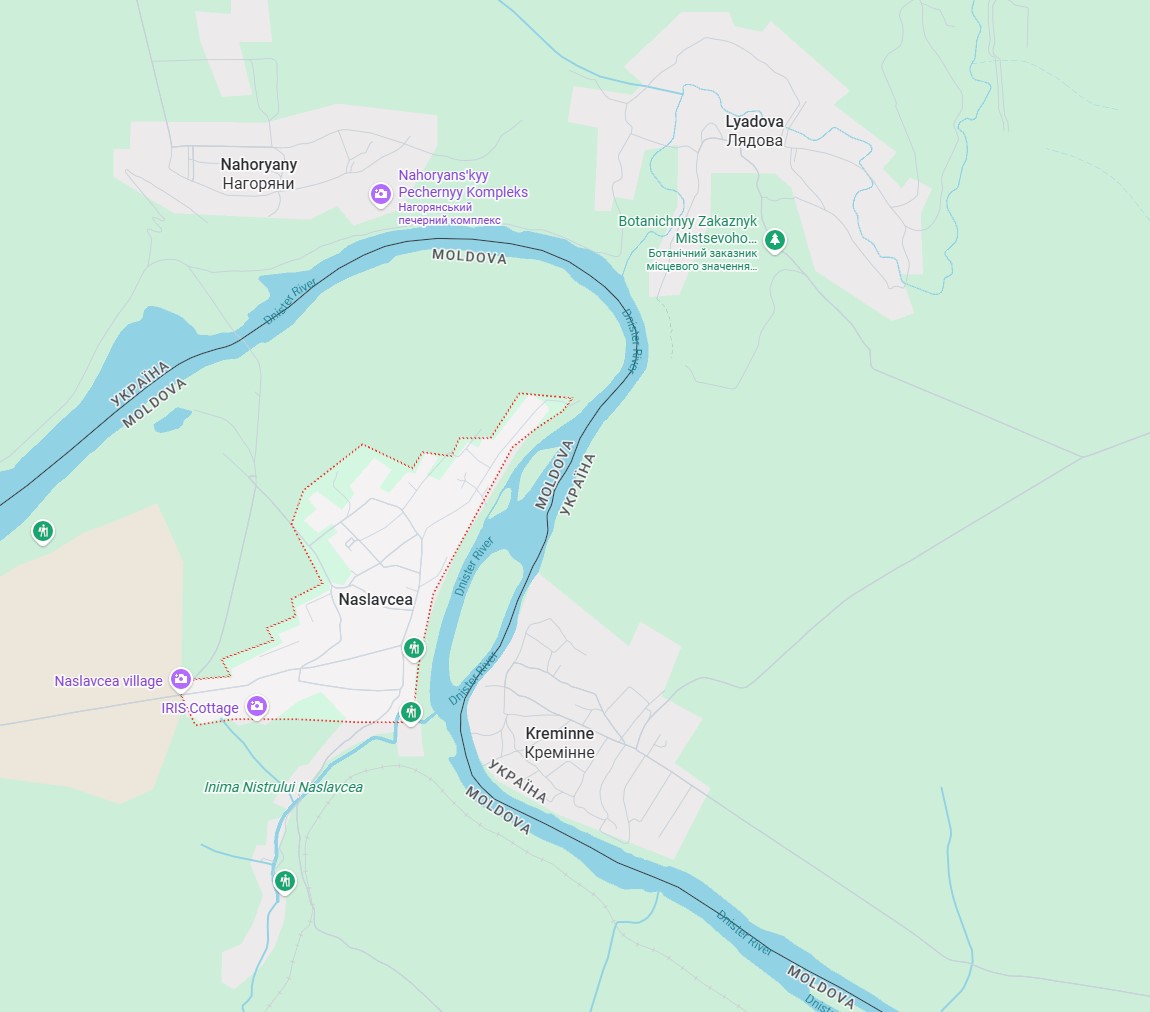
This theory was also denied by representatives of the Ministry of Environment. According to them, any upstream leakage (in the direction the water comes from) is excluded. Officials pointed out that the first stains were observed in the Naslavcea area, which is about 30 kilometers upstream from Otaci.
Journalists contacted Ruslan Verbițchi to find out more details, including whether he has evidence to confirm his version. In response, the former city councilor said that his source of information is “from the inhabitants of the north of the country“.
In support of his version, Verbițchi drew our attention to the fact that, from the moment the leakage in the Nistru was detected, the inhabitants of Otaci were never cut off from the supply of drinking water.
“The inhabitants of Otaci have water. Even from the first day, since the problem appeared, their water supply was never cut off“, he said.
To verify the politician’s statements, we contacted the mayor of Otaci, Dmitrii Zavroțchii, who labeled the stories told by Verbițchi as disinformation. Like the Police, the mayor also denied the information about the overturned truck.
Regarding the cessation of water supply for the inhabitants of Otaci, the mayor stated that this is not necessary, and this is because the city does not get its water supply from the Nistru.
“We have artesian wells. We take water from them. We do not consume water from the Nistru“, declared the mayor of Otaci, who confirmed that in the last few days oil stains were observed on the river.
Another falsehood spoken by Ruslan Verbițchi refers to the fact that “even the Ukrainian authorities do not know the real source of pollution“. This statement contradicts the official position of the Ministry of Economy, Environment and Agriculture of Ukraine, which announced last week that, following Russia’s attack on the Nistru Hydroelectric Power Station in the Chernivtsi region, pollutant stains were observed in the Liadova village area, from the Vinnytsia region (about 10 kilometers upstream from Naslavcea). At the same time, Kiev specified that the authorities of the Republic of Moldova were also informed about the incident.

The purpose of this campaign, launched a few hours before the summoning of the agreed ambassador of Russia, Oleg Ozerov, to the Ministry of Foreign Affairs in Chișinău, is clear – to create uncertainty, to undermine people’s confidence, to generate confusion about the real source of pollution and to create a negative attitude of citizens against Ukraine, which would also affect Moldovan-Ukrainian bilateral relations. In this context, citizens are urged to inform themselves only from safe and reliable sources.