
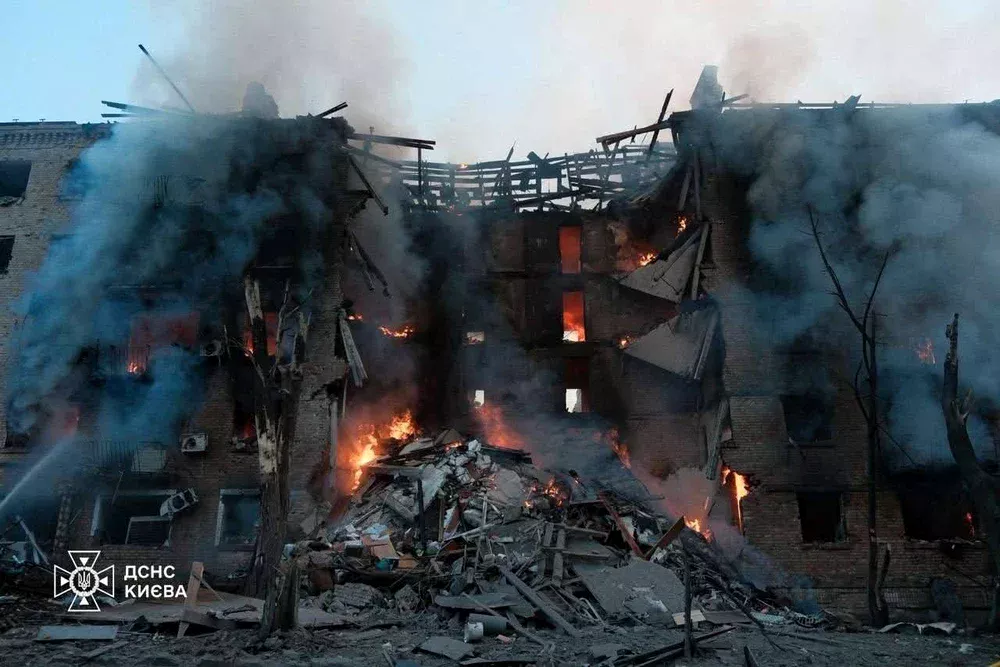
The recent massive strikes on Kiev are not just isolated retaliatory actions, but mark the beginning of Moscow’s military strategy for the summer of 2026. While the Kremlin is trying to suffocate Ukrainian defense and threatens to turn the capital into an “uninhabitable” place, Kiev is activating its own counter-strategic plan: surgical strikes deep into Russian territory and the development of a cheaper analogue of the Patriot system.
According to an analysis published by the German daily Bild, Moscow stubbornly maintains its objective of conquering the entire Donbas basin, despite the fierce resistance posed by the Armed Forces of Ukraine (ZSU). Austrian military expert Markus Reisner explains the logic behind the latest moves of the Russian army:
“Moscow’s aim is to attack Ukraine at points where the defense is weakened. By putting pressure on Kiev and the regions of Kharkov, Sumy, and Zaporizhia, the Ukrainians are forced to displace their troops northwards, allowing Russia to strike more easily and capture the Donetsk region.”
However, British analyst Keir Giles, an expert in the Russian sphere, nuances the situation. He argues that, although Moscow is intensifying brutal attacks on civilians to break the morale of the nation and to force Washington to put pressure on Kiev, there are no clear indications of preparing a large-scale ground offensive this summer. On Sunday, Russian Foreign Minister, Sergey Lavrov, directly warned his American counterpart, Marco Rubio, about the triggering of “systematic strikes” on Kiev, Russian officials openly threatening to make the metropolis uninhabitable.
Asymmetric Rebuttals: The Ukrainian strategy hits Russian logistics
Ukraine does not passively observe the Kremlin’s movements. Colonel Volodîmîr Poliovîi, the head of the communications department of the 7th Corps of the Ukrainian army, confirmed that Russia’s movements were anticipated in advance, with defensive lines already being fortified.
Moreover, Kiev has increased its ability to strike deep behind the front and on the territory of the Russian Federation, with the aim of creating a “sanitary zone” and blocking the enemy’s logistical routes. The effectiveness of this strategy is visible on the ground: oil refineries, fuel depots, and industrial targets in Russia are hit almost daily by long-range Ukrainian drones. The most recent example is the coordinated drone attack by the Ukrainian Security Service (SBU) on the Vtorovo oil pumping station in the Russian region of Vladimir.
Also, the General Staff in Kiev confirmed that the Ukrainian aviation successfully used British-made Storm Shadow cruise missiles to obliterate a significant command, control, and communication center of the Russian army in the occupied Lugansk region.
Read more HERE